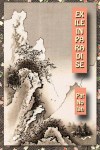
Exile In Paradise“is alive with details to coax our attention, urge our sensitivity to the present. Little happens while everything happens. . .Poems arise from the mists of west county. . .Only nature and the moment exist.” —Robert Feuer, Sonoma County Gazette
(read the entire review in the Sonoma County Gazette)
The poems of Exile In Paradise are derived from a lifelong appreciation of classical Chinese poetry. This selection by Pat Nolan marks an almost fifty year creative engagement with Asian literature in translation. Chinese poetry is image rich and largely dependent for its overall effect on the juxtaposition of these images in a discontinuous thread that is not unlike the successive frames of a film. Each of the poems finds its origin in a line translated from an ancient Chinese poet. Although removed by degrees of separation from the originals in time and language, their impulse remains the same: to call up the perceptual as a song of celebration in sacred engagement with the world.
More Praise for Exile In Paradise
“Nolan has given Solitude, itself, a voice in this rich lyric of nature. A luminosity of flickering bursts pause and magnify now moments of being alive. His quotidian soaks us with its presence. His lines trace the air.” —Maureen Owen, author of Erosion’s Pull and Edges of Water
“Reading these poems, I feel like I’m walking down a village lane somewhere in China, beyond the reach of the emperor’s minions, and every door I walk by, someone invites me in for a cup of wine. At this rate, I don’t think I’ll ever make it out of here, and why should I?” —Bill Porter (Red Pine), translator, author of Finding Them Gone: Visiting China’s Poets from the Past
Pat Nolan has lived in silent cunning exile along the Russian River in Northern California for over forty years. His poetry, prose and translations have appeared in numerous literary magazines and anthologies in North America, Europe and Asia. He has worked as a bartender, rock band manager, trail crew grunt, radio DJ, janitor, preschool teacher, and emergency dispatcher. The author of three novels and over a dozen poetry books, he is also publisher of Nualláin House, Publishers and maintains the literary blog for The New Black Bart Poetry Society.
Exile In Paradise November, 2017
$16.00~paper~100 pages~6×9~ISBN 978-0-9840310-5-4
is available exclusively from the publisher
(locally at Many Rivers Books & Tea Sebastopol, CA) Go toHow To Orderfor details
Purchase two or more titles
and get free shipping
anywhere in the US
(see How To Order for details)
Also available through our partnership with Bamboo Leaf Studio
Linoleum Block Prints
from the Smoking Poets series
W.H. Auden 5×7 $40
Andre Breton 4×6 $20
Roberto Bolano 5×7 $40
Charles Bukowski 5×7 $40
Ted Berrigan 5×7 $40
Dylan Thomas 4×5 $30
Pierre Reverdy 4×6 $20
Samuel Beckett 5×7 $40
Blaise Cendrars 5×7 $40
Marcel Duchamp 6×9 $50
Jean Cocteau 5×7 $40
Vladimir Mayakovsky 5×7 $40
and the Faux Koan series by Pat Nolan
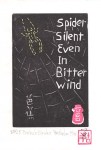
Spider $10 4×6
This Moment $40 6×9
The More $40 6×9
Kicked A Clump $40 6×9
Everytime $40 6×9
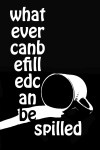
Whatever $40 6×9
Order two or more prints
get free shipping
and receive a bonus broadside of
the limited edition
Dylan Thomas print accompanied by Pat Nolan’s Advice To A Young Poet Free!!
“Nolan has given Solitude, itself, a voice in this rich lyric of nature. A luminosity of flickering bursts pause and magnify now moments of being alive. His quotidian soaks us with its presence. His lines trace the air.” —Maureen Owen, author of Erosion’s Pull and Edges of Water
“Reading these poems, I feel like I’m walking down a village lane somewhere in China, beyond the reach of the emperor’s minions, and every door I walk by, someone invites me in for a cup of wine. At this rate, I don’t think I’ll ever make it out of here, and why should I?” —Bill Porter (Red Pine), translator, author of Finding Them Gone: Visiting China’s Poets from the Past
The poems of Exile In Paradise are derived from a lifelong appreciation of classical Chinese poetry. This selection by Pat Nolan marks an almost fifty year creative engagement with Asian literature in translation. Chinese poetry is image rich and largely dependent for its overall effect on the juxtaposition of these images in a discontinuous thread that is not unlike the successive frames of a film. Each of the poems finds its origin in a line translated from an ancient Chinese poet. Although removed by degrees of separation from the originals in time and language, their impulse remains the same: to call up the perceptual as a song of celebration in sacred engagement with the world.
Pat Nolan has lived in silent cunning exile along the Russian River in Northern California for over forty years. His poetry, prose and translations have appeared in numerous literary magazines and anthologies in North America, Europe and Asia. He has worked as a bartender, rock band manager, trail crew grunt, radio DJ, janitor, preschool teacher, and emergency dispatcher. The author of three novels and over a dozen poetry books, he is also publisher of Nualláin House, Publishers and maintains this literary blog.
Failed in Letters Happy in Life
“Cherishing my ineptness I’m carefree to the end” enjoying a little peace cup of herb tea cold
attentive to the sound of the eaves overflowing
after a rush of late winter rain passes through
where I have gone wrong fills many notebooks
file cabinets bulging with personal hyperbole
here mistake after mistake accumulates like dust
documents of my timeless imperfection
FREE SHIPPING ~offer has been extended through November 15th, 2017~ FREE SHIPPING
Exile In Paradise November, 2017
$16.00~paper~100 pages~6×9~ISBN 978-0-9840310-5-4
is only available from the publisher Go toHow To Orderfor details
Exile In Paradise by Pat Nolan will be available early November, 2017 Order before October 31st, 2017 and get free shipping (see How To Order for details)
ISBN 978-0-9840310-5-4~ 6×9~ paper~100 pages~$16
The poems of Exile In Paradise are derived from a lifelong appreciation of classical Chinese poetry. This selection by Pat Nolan marks an almost fifty year creative engagement with Asian literature in translation. Chinese poetry is image rich and largely dependent for its overall effect on the juxtaposition of these images in a discontinuous thread that is not unlike the successive frames of a film. Each of the poems finds its origin in a line translated from an ancient Chinese poet. Although removed by degrees of separation from the originals in time and language, their impulse remains the same: to call up the perceptual as a song of celebration in sacred engagement with the world.
Praise for Exile In Paradise
“Nolan has given Solitude, itself, a voice in this rich lyric of nature. A luminosity of flickering bursts pause and magnify now moments of being alive. His quotidian soaks us with its presence. His lines trace the air.” —Maureen Owen, author of Erosion’s Pull and Edges of Water
“Reading these poems, I feel like I’m walking down a village lane somewhere in China, beyond the reach of the emperor’s minions, and every door I walk by, someone invites me in for a cup of wine. At this rate, I don’t think I’ll ever make it out of here, and why should I?” —Bill Porter (Red Pine), translator, author of Finding Them Gone: Visiting China’s Poets from the Past
The Hand of an Old Friend
“Day’s late glazing rays already deep in the yard”
as a bee in amber I’m captured by a rich light
faint breeze rustles bamboo grove half in shadows
that sense of well being so fleeting visits again after
days of feeling like someone’s standing on my heart
The poems of Exile In Paradise are derived from a lifelong appreciation of Chinese poetry. Originally published as a selection in limited edition by Bamboo Leaf Studio in 2010, this further iteration of eighty poems by Pat Nolan marks an almost fifty year creative engagement in comparative literature with Chinese prosody. Chinese poetry is image rich and largely dependent for its overall effect on the juxtaposition of these images in a discontinuous thread that is not unlike the successive frames of film. Each of the poems in Exile In Paradise finds its origin in a line translated from an ancient Chinese poet. The body of the poem consists of an improvisation from that line with the aim of using elements of Chinese prosody such as parataxis and parallelism while being cognizant that Chinese nouns have no number, verbs have no tense, few if any conjunctions or prepositional indicators, and that each line contains its own integrity, apart from any overarching discursive intent. The poems of Exile In Paradise, while clearly original, endeavor to achieve a synthesis between a historically distant culture and the contemporaneous radically different literature of today.
from the introduction to Exile In Paradise by Pat Nolan: Some fifty years ago a friend loaned or gifted me Kenneth Rexroth’s One Hundred Poems from the Chinese, and as is commonly acknowledged a loaned book is often an unintended gift. The immediacy of these translations rests on their plain spoken imagism. Undoubtedly much of that is due to Rexroth being of the Williams-Pound tell-it-as-you-see-it persuasion of American poetry. The gift was my introduction to Chinese poetry. What at first was merely idle curiosity has become a lifelong passion leading me to read just about everything I can find relating to Chinese poetry, from Witter Bynner to Mike O’Connor. Over the years I have assembled a library of anthologies and collections beginning with Arthur Waley’s Translations from the Chinese and Robert Payne’s The White Pony to more current editions complied by translators Burton Watson, Jonathan Chaves, David Hinton and Red Pine (Bill Porter). With each collection or critical study I learn something new.
Free-lance Illustrator/Graphic Artist Michael Fisher has lived in Sonoma County for forty four years, primarily in the West County in and around the town of Monte Rio. Over the years his illustrations and poster designs have been used to advertise scores of music venues, rock concerts, literary events and projects, and local businesses. In the tradition of jack-of-all-(artistic) trades, Michael was once a popular bartender (perhaps the most popular) at the pre ’86 flood Village Inn in Monte Rio where between shaking, stirring, and pouring he managed to produce a pithy comic strip entitled Malice In Blenderland which was featured in Sonoma County’s original independent newspaper of the 70’s and 80’s, The Sonoma County Stump.
Along with his free-lance gigs as an illustrator, Michael was also active in the local musical theater scene where he was the featured performer for such popular productions as Little Shop of Horrors and Dracula-la. And many will remember that he once fronted the oldies rock band, The Grey Cats, as lead singer and harmonica, and whose annual Halloween productions were delightfully beyond words. Grey Cats flyers and concert posters designed by Michael Fisher are now considered collector’s items by the hip cognoscenti. Although probably apocryphal, it is believed that one of Michael’s early inspirations was Gypsy Rose Lee’s theme song, Let Me Entertain You. His wit and spontaneity are always on display often centered on his awesome encyclopedic knowledge of arcane and weird pop trivia. His playfulness and readiness to entertain served him well in his long career in children’s services where he was also just one of the kids. Now retired, Michael is devoting himself to his first love, drawing, with nearly daily postings to his blog, Aldo & Me.
To say that Michael’s cartooning style is ‘old school’ might be an understatement. Anyone familiar with the underground comics of the 60’s counterculture will recognize the stylistic similarities. The same wacky and irreverent world views of R. Crumb, S. Clay Wilson, and Gilbert Shelton are present in Michael’s panels. However his influences in cartooning go back even further to the likes of Jimmy Hatlo, Al Capp’s L’il Abner, and Walt Kelly’s Pogo. What is evident of Michael’s skills is a unique virtuosity and imagination as is amply expressed in the sold out limited edition of his 2017 Aldo & Me West Sonoma County Calendar. (As of this writing, a few were still available for sale at the 5&10 in Guerneville). His versatility in illustration is not limited to a narrow range of renderings but encompasses the entire array of contemporary comic arts, from South Park and Peanuts to the Simpsons.
A word about Michael Fisher’s virtuosity and range of illustrating talents: unique in an artist’s repertoire is the ability to see three dimensions and translate them into a depiction of two dimensions while providing the illusion of a third through modeling, shadowing, and textural crosshatching. Michael is the master of all such techniques and his expert renditions testify to his imagination and illustrative skills. Not unexpected for someone who has spent a lifetime perfecting his gift for illustration. The accomplished depictions mirror a whimsical ruefully aware sensibility scripted in the dialogue bubbles as well as through the illusionist stroke of a drawn line and its suggestive minimalism, as demonstrated by a profound intuition of how the eye sees and distinguishes abstract representation. Even the simplest of his sketches retain the vitality of their representation. His knack for breaking down the visual world to its basic components enables him to present those objects in a variety of ways by re-imagining them as abstract design elements.
To the literate of the comic strip genre, the subtleties of a work of illustration lie beneath the message. As such cartoon depictions constitute a visual language. Michael is quite fluent in a variety of the style dialects of this language. The near daily postings on his blog Aldo & Me attest not only to his genius as an illustrator but the seemingly inexhaustible consistency of his output. The sheer creative energy expended can undoubtedly be measured in kilowatts.
As compositions the drawings and sketches of an accomplished artist like Michael offer an originality in variation and theme that speaks of a unified aesthetic. His command of the stylistic elements of the genre is truly astonishing. Confident of his proficiency, he once made an offer to friends and fans alike to include any one of them in his blog strip and to depict them as any cartoon character or in any style they desired. For a fee, of course. Not surprisingly, a few jumped at the chance. Presumably that offer is still in effect.
courtesy of the King/Nolan Collection
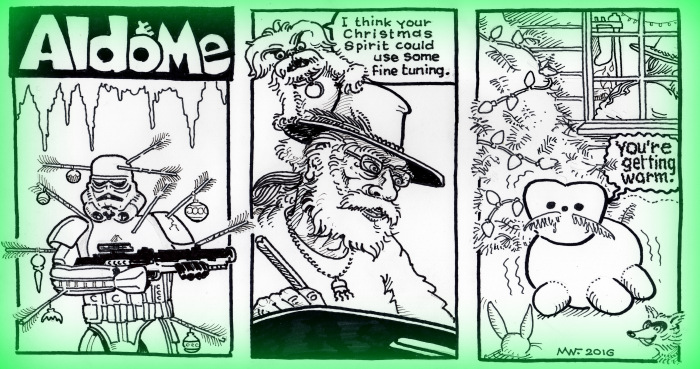
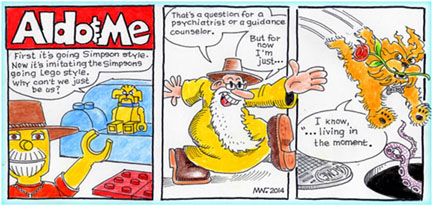
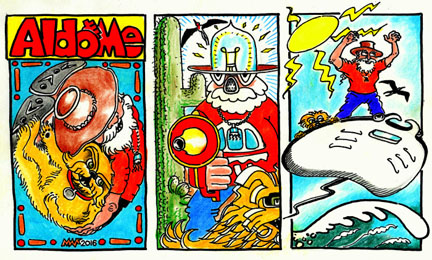
Michael’s talented renditions are available for perusal as a three panel cartoon blog, Aldo & Me, where he has regularly posted his pithy and often wacky interactions and observations on the WordPress platform for the past five years. For the most part the panels are joyful and lighthearted entertainment depicting the dialogue between a man and his dog (maybe that should be dogalogue) as observations and commentary on the vicissitudes of life. On occasion, barbed and pointed sarcasm emerges from the mild mannered strip in the guise of the super illustrator, The Doodler (he of the pencil extension) and his faithful companion, large fanged enforcer Alldog. A humming bird and an extraterrestrial jelly fish also join in the discourse as does a South of the Border feline, Furnando. The consciousness behind Aldo & Me exhibits an evolved earth conscious awareness of one of the intelligent of the species as represented by a temperate self-deprecating humor and playfulness whose discerning perceptions always hit their mark whether it is lampooning the pompous or jarring the funny bone.
from Fundamental, Toy Poems (1983) by Pat Nolan-Stencil design by Michael Fisher
As with earlier (and rare) posters and flyers, Michael Fisher’s Aldo & Me original panels are catching on with the more knowledgeable as must-have collector’s items. It is a sure sign of being au courant to have a few signed Fishers tastefully framed on display throughout the household where a guest or visitor might happen upon them and be delighted by the remarkable talent, not to mention the possessor’s discerning taste.
Although a California transplant by way of Florida (also known for its citrus), Michael Fisher has adopted an age old Californios tradition of migrating south from Alta California during its chilly, flood-prone rainy season to the sunny congenial climes of Baja California and the little village of Todos Santos on the Pacific shore. There the artist can stretch out on his hammock, watch the lizards scurry along the walls of the hacienda, and bask in the leisure of his creative energy. That’s where he is right now, knocking out terrific three panel entertainments such as these:
This slideshow requires JavaScript.
Michael Fisher is a working artist and illustrator. His almost daily exercises in the illustrators art can be viewed at aldome.wordpress.com. Once on site, intrepid internet travelers can click on the Aldo’s Shop & Bark link in the sidebar (on the left hand side just below the header) to sample some of the pencil magic available for purchase, as well as information on how to get in touch with Michael and make one of his fantastic works of art your own.
20% Off on All Titles & Free Shipping*
(offer good thru 12/31/15)
Order all five titles and save even more!
Get all five Nualláin House titles for just $60!! Save over $20!!!
*(free shipping in US only)
Send check or money order
(made payable to ‘Pat Nolan’)
for the listed Sale price to
Nualláin House, Publishers
Box 798 Monte Rio, CA 95462.
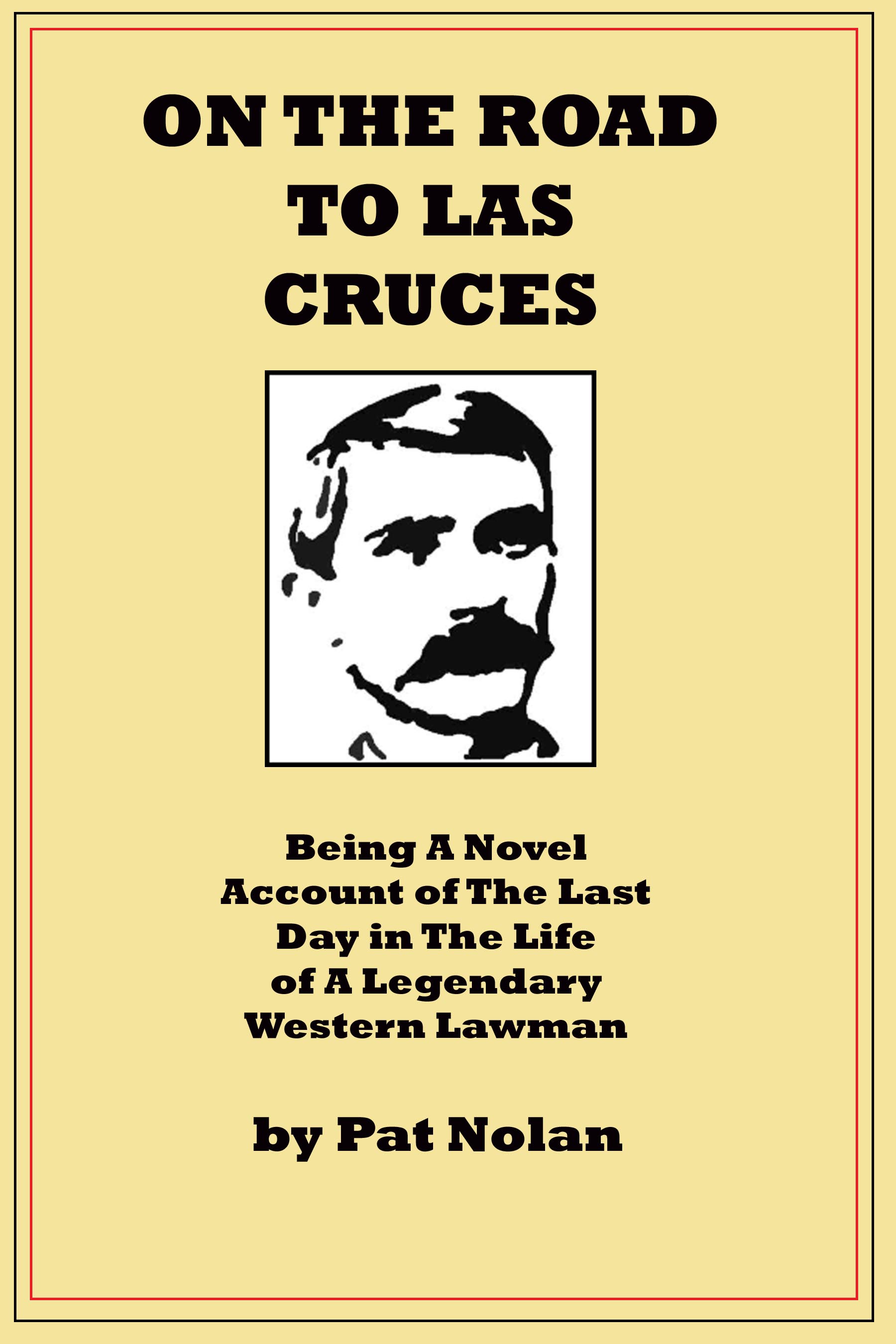
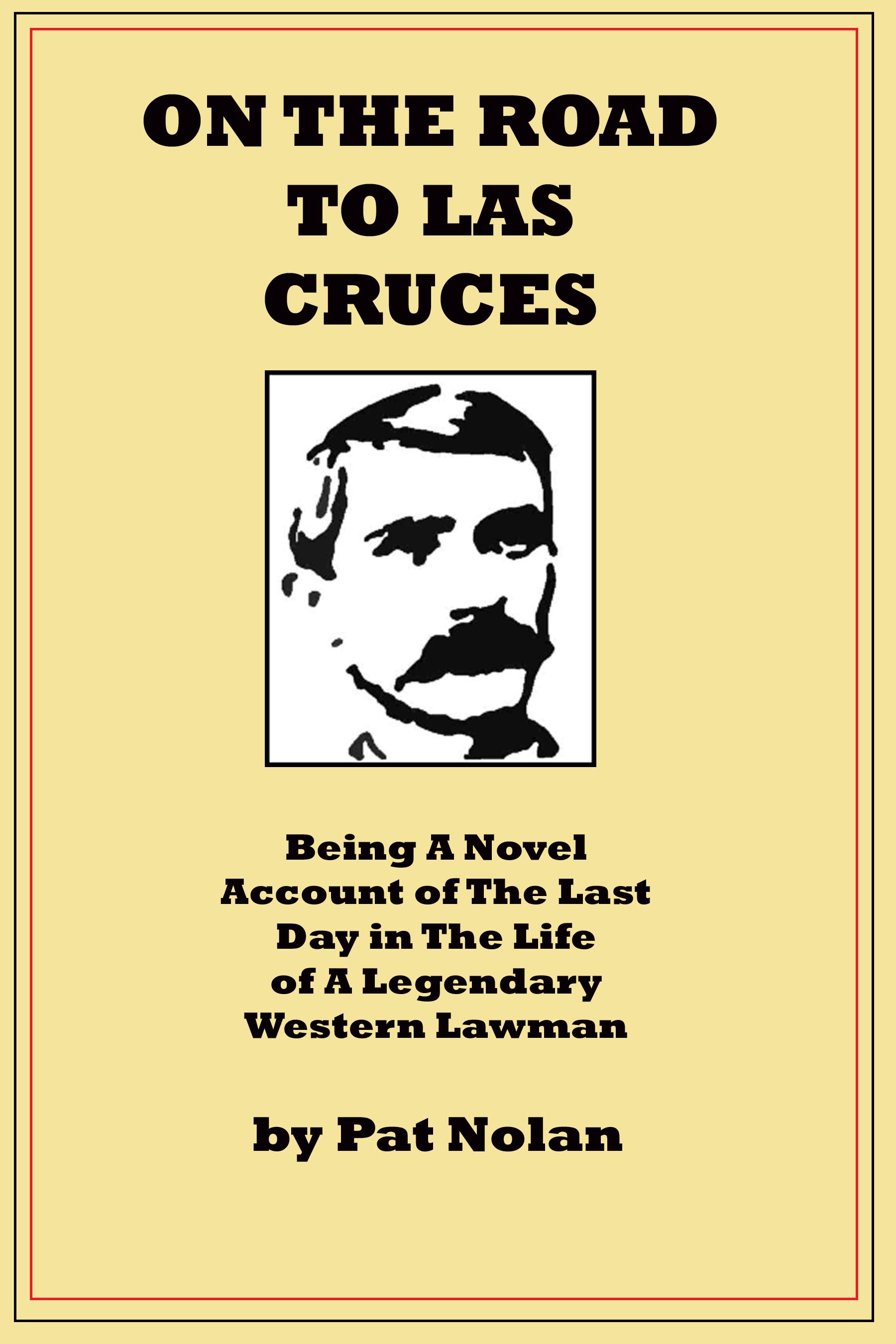
ON THE ROAD TO LAS CRUCES; Being A Novel Account of The Last Day In The Life of A Legendary Western Lawman by Pat Nolan
Pat Nolan’s first published novel, On The Road To Last Cruces; Being A Novel Account of The Last Day In The Life of A Legendary Western Lawman is the story of youthful bravado and an old man’s regret, and as much a dusty tale of buffalo hunts and shoot-outs as a politically driven “whodunit.” November 2011 ~ 154 pages
THE LAST RESORT A Lee Malone Adventure by Pat Nolan
Pat Nolan has written a fast paced, tongue-in-cheek, pun filled comedy of errors, misunderstandings, and faux intuition in the mode of a 1930’s pulp thriller. Instead of the typical splinter-jawed, broken nosed, tobacco breathed tough guy hero, Nolan upends the stereotype by introducing a gorgeous internationally famous former fashion model whose super power is her beauty.
August 2012~ 212 pages
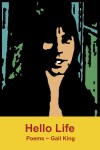
HELLO LIFE Poems by Gail King
The poems of Hello Life achieve their freshness in the particularity of experience. The poet surrenders herself to the moment and tenders that subtle cognition as a delighted welcome to life. The ease of her expression in dealing with the everyday communicates an uncommon wisdom. The poems present, through playful understatement and sly humor, the immediacy of spontaneous impressions.
December 2013 ~ 64 pages
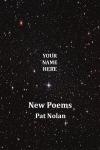
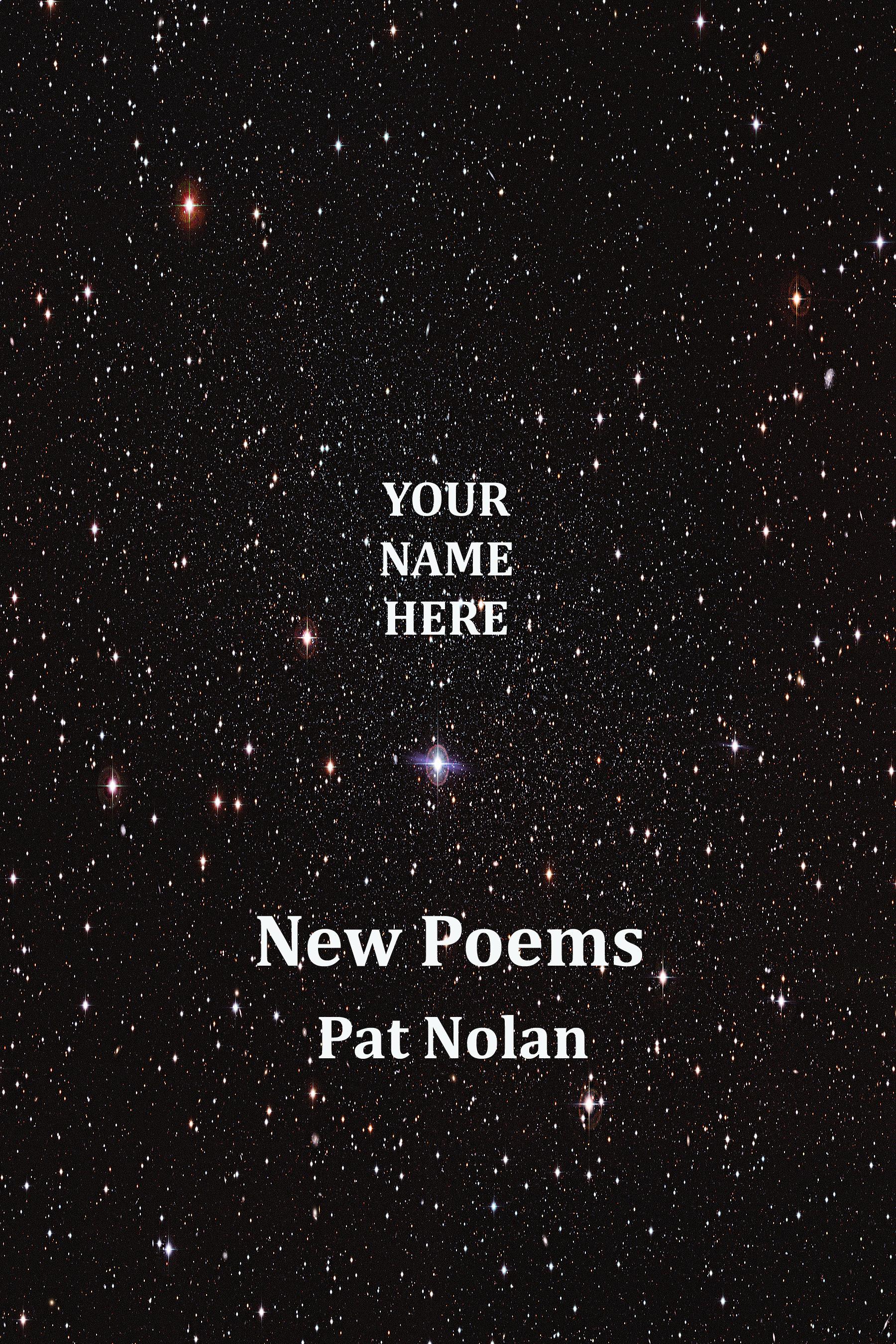
Your Name Here New Poems by Pat Nolan
The poems in Your Name Here revolve around that quantum axis with seemingly random discontinuities that do not pin down meaning but are left to mean themselves. Nolan’s poetry enacts a sub-vocal monologue that is like the murmur of cosmic background radiation, noticeable only in its cessation or as pauses when the mind registers the sum of discrete moments in an instant. November 2014 ~ 80 pages
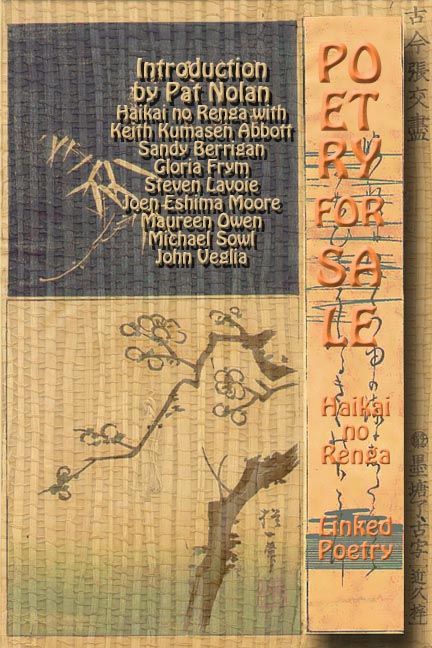
Poetry For Sale Haikai no Renga (Linked Poetry)
Introduction by Pat Nolan The eleven haikai no renga included in Poetry For Sale were written over period of nearly thirty years by Pat Nolan and his renku collaborators, Keith Kumasen Abbott, Sandy Berrigan, Gloria Frym, Steven Lavoie, Joen Eshima Moore, Maureen Owen, Michael Sowl, and John Veglia. In these pages haikai no renga is synthesized as a brief, highly suggestive, well spoken, maddeningly ambiguous, read-between-the-lines kind of poetry tuned to a common understanding. October 2015 ~ 152 pages
OCTOBER 2015 Order Now & Get Free Shipping!
(Sorry, Free Shipping Available
To North American Destinations Only) Offer Good Through October 15, 2015
Poetry For Sale
Haikai No Renga (linked poetry) Introduction by Pat Nolan Haikai no Renga with
Keith Kumasen Abbott, Sandy Berrigan, Gloria Frym,
Steven Lavoie, Joen Eshima Moore,
Maureen Owen, Michael Sowl,
and John Veglia.
The eleven haikai no renga included in Poetry For Sale were written over period of nearly thirty years by Pat Nolan and his renku collaborators, Keith Kumasen Abbott, Sandy Berrigan, Gloria Frym, Steven Lavoie, Joen Eshima Moore, Maureen Owen, Michael Sowl, and John Veglia. This collection of linked poetry presents a fascinating excursion in comparative literature by a cross-section of exceptional, widely-published American poets. What these poets bring to the collaborative linking of stanzas is a visceral sense of the poetic that transcends two disparate languages and the gap of centuries. In these pages haikai no renga is synthesized as a brief, highly suggestive, well spoken, maddeningly ambiguous, read-between-the-lines kind of poetry tuned to a common understanding.
October 2015 ~ 152 pages ~ $16 ~ paper ~ ISBN978-0-9840310-4-7
click on the How To Order tab for more information
from HARDLY STRICTLY HAIKAI —An Introduction—
Haikai no Renga is collaborative poetry of Japanese origin normally written by two or more poets linking stanzas of 17 syllables and 14 syllables according to specific rules governing the relationship between stanzas. Haikai collaboration can be as complex as chess, as multi-dimensional as go, and as fast-paced and entertaining as dominoes. It is as much about the interaction of the poets as it is about what gets written. The forward progress of its improvisation is akin to that of a tight jazz combo. Haikai composition has also been compared to montage in experimental film where the discontinuity of images and vectors achieves an integral non-narrative expression.
Haikai no renga is known variously as renga, haikai, renku, and linked poetry. Generally the term renga is applied to an older, more traditional style of linking poetry practiced by the aristocracy and the upper echelon of medieval Japanese society. Haikai no renga means “non-standard renga” though it has often been translated as “mongrel” or “dog renga” which places it in the literary hierarchy as common entertainment.
In the introduction to her seminal study of Matsuo Basho’s haikai no renga, Monkey’s Raincoat (Grossinger/Mushinsha, 1973), Dr. Maeda Cana offers a further explication of the word haikai. “The main characteristics of the haikai are partly discernible in the kanji or Chinese characters which make up the words haikai and renku: hai denotes fun, play, humor, and also actor or actress, and kai friendly exchange of words; ren represents a number of carriages passing along a road one after another and has the meaning of continuing to completion while ku is expressive of the rhythmic changes in speech and denotes end or stop.”
Renku is a literary game of high seriousness valuing cooperation and rewarding intelligence as well as intuition. A poet’s erudition and sense of language are called upon to clear paths and build bridges that will meander through the landscape of a literary garden. Its cooperative result, a balance of unpredictable language gestures as insubstantial as smoke but possessed of a palpable humanity, is what is important. The echo of the response, its relationship to the previous stanza, and how it extends its meaning, poignantly or allusively, is the esthetic ground for this kind of poetry. The linking process, in renga, and in haikai, allows a sequence whose subtle oscillation of playfulness and gravity walk the tightrope of language’s built-in ambiguities.
“Generally speaking, haikai is steeped in the wit and banter” as Dr. Cana explains, and “it has a brilliance that shocks. Such brilliance is continual and amazes. . .at every turn.” Poets are under pressure to produce the unpredictable so that the possibilities of cleverness are continually exploited at a tempo that is swift and witty. The haikai poets of old delighted in word play, literary allusions, double entendres as well as displays of authentic sensibility. The completed renku is as much a certificate of cooperation as it is a multi-page poem and a sequence of short poems. Its literary value is in its effervescent spontaneity and transitory nature, a quality much appreciated by the Japanese.
From Nualláin House, Publishers OCTOBER 2015 Order Now & Get Free Shipping! (Offer Good Through October 15th)
Haikai no Renga is collaborative poetry of Japanese origin normally written by two or more poets linking stanzas of 17 syllables and 14 syllables according to specific rules governing the relationship between stanzas. Haikai collaboration can be as complex as chess, as multi-dimensional as go, and as fast-paced and entertaining as dominoes. It is as much about the interaction of the poets as it is about what gets written. The forward progress of its improvisation is akin to that of a tight jazz combo. Haikai composition has also been compared to montage in experimental film where the discontinuity of images and vectors achieves an integral non-narrative expression.
Haikai no Renga also known as renku is a literary game of high seriousness valuing cooperation and rewarding intelligence as well as intuition. A poet’s erudition and sense of language are called upon to clear paths and build bridges that will meander through the landscape of a literary garden. Its cooperative result, a balance of unpredictable language gestures as insubstantial as smoke but possessed of a palpable humanity, is what is important. The echo of the response, its relationship to previous stanza, and how it extends its meaning, poignantly or allusively, is the esthetic ground for this kind of poetry. The linking process, in renga, and in haikai, allows a sequence whose subtle oscillation of playfulness and gravity walk the tightrope of language’s built-in ambiguities.
The eleven haikai no renga included in Poetry For Sale were written over period of nearly thirty years by Pat Nolan and his renku collaborators, Keith Kumasen Abbott, Sandy Berrigan, Gloria Frym, Steven Lavoie, Joen Eshima Moore, Maureen Owen, Michael Sowl, and John Veglia. This collection of linked poetry presents a fascinating excursion in comparative literature by a cross-section of exceptional, widely-published American poets. What these poets bring to the collaborative linking of stanzas is a visceral sense of the poetic that transcends two disparate languages and the gap of centuries. In these pages haikai no renga is synthesized as a brief, highly suggestive, well spoken, maddeningly ambiguous, read-between-the-lines kind of poetry tuned to a common understanding.
October 2015 ~ 152 pages ~ $16 ~ paper ~ ISBN978-0-9840310-4-7 go to How To Order page for more information
Haikai no Renga
(Linked Poetry) Introduction by
Pat Nolan
Haikai no Renga with Keith Kumasen Abbott,
Sandy Berrigan, Gloria Frym, Steven Lavoie, Joen Eshima Moore, Maureen Owen, Michael Sowl,
and John Veglia
FromHARDLY STRICTLY HAIKAI
—An Introduction—
Haikai no Renga is collaborative poetry of Japanese origin normally written by two or more poets linking stanzas of 17 syllables and 14 syllables according to specific rules governing the relationship between stanzas. Haikai collaboration can be as complex as chess, as multi-dimensional as go, and as fast-paced and entertaining as dominoes. It is as much about the interaction of the poets as it is about what gets written. The forward progress of its improvisation is akin to that of a tight jazz combo. Haikai composition has also been compared to montage in experimental film where the discontinuity of images and vectors achieves an integral non-narrative expression.
Haikai no renga is known variously as renga, haikai, renku, and linked poetry. Generally the term renga is applied to an older, more traditional style of linking poetry practiced by the aristocracy and the upper echelon of medieval Japanese society. Haikai no renga means “non-standard renga” though it has often been translated as “mongrel” or “dog renga” which places it in the literary hierarchy as common entertainment.
Renku is a literary game of high seriousness valuing cooperation and rewarding intelligence as well as intuition. A poet’s erudition and sense of language are called upon to clear paths and build bridges that will meander through the landscape of a literary garden. Its cooperative result, a balance of unpredictable language gestures as insubstantial as smoke but possessed of a palpable humanity, is what is important. The echo of the response, its relationship to previous stanza, and how it extends its meaning, poignantly or allusively, is the esthetic ground for this kind of poetry. The linking process, in renga, and in haikai, allows a sequence whose subtle oscillation of playfulness and gravity walk the tightrope of language’s built-in ambiguities.
The eleven haikai no renga included in Poetry For Sale were written over period of nearly thirty years by Pat Nolan and his renku collaborators, Keith Kumasen Abbott, Sandy Berrigan, Gloria Frym, Steven Lavoie, Joen Eshima Moore, Maureen Owen, Michael Sowl, and John Veglia. This collection of linked poetry presents a fascinating excursion in comparative literature by a cross-section of exceptional, widely-published American poets. What these poets bring to the collaborative linking of stanzas is a visceral sense of the poetic that transcends two disparate languages and the gap of centuries. In these pages haikai no renga is synthesized as a brief, highly suggestive, well spoken, maddeningly ambiguous, read-between-the-lines kind of poetry tuned to a common understanding.
Pre-orders now being accepted. Place your dibs at nuallainhousepublishers.gmail.com
























 nuallainhousepublishers.com