Tag Archives: Maureen Owen

Praise for YOUR NAME HERE


Praise for Your Name Here, New Poems
by Pat Nolan

“The book itself takes no prisoners.”
—Lucille Friesen, poet, printer

“Pat Nolan is one of the poets, Ted Berrigan once said, that you have to always keep an eye on because he can do unexpected startling things that leave you eating his dust. What was once “irony,” which is that generous distance of youth regarding itself in the odd act of “seeing” and “scratching” words became an essential tool to survive as poet. Pat Nolan’s poetry has indeed survived, with the help of not just the luxury of irony, but also the blending of his secretly bilingual (French-Canadian and American) language, his intensely questioned, but never renounced, faith in poetry. Add to this work, the joyous and extensive reading of a profound autodidact with an active and sometimes polemical involvement in the “literary scenes” of the West and East coasts for better than half a century, and you have, standing suddenly in front of you, a poetry giant.”
— Andrei Codrescu, author of Bibliodeath: My Archives (with Life in Footnotes), and So Recently Rent a World: New and Selected Poems, 1968-2012.

“Nolan’s painterly sensitivity unfolds a delicate beauty that breathtakingly fuses nature with a Surrealistic philosophic questioning and meditative soul searching. Descriptions of nature so translucent we can only marvel how he weaves us into them, onward, around that eternal share of misfortune, bitter realization, and expectations gone wrong. This is Nolan’s secret power.  He engages us in magical transformation and will not let us look away.”
— Maureen Owen, author of Erosion’s Pull and Edges of Water

“. . .reminded me of James Joyce in that brief moments can become long & engrossing & turn the page for you despite any wishes thoughts & warnings you may have about more . . . .”
—Keith Abbott, poet, professor emeritus, and author of Downstream From Trout Fishing In America, A Memoir.

“The poems glow with insight and wit as they simply monitor the flow of a mind steeped in Chinese poetry, bebop, the Russian River, the beats, the birds, Heraclitus. . . .  [Nolan] in his own words, is an alphabet male.  And despite the breadth of his learning and thought, is always just talking from right here.  It’s a hell of a book.”
—Eric Johnson, poet and print master at Iota Press.
YNHcvrj


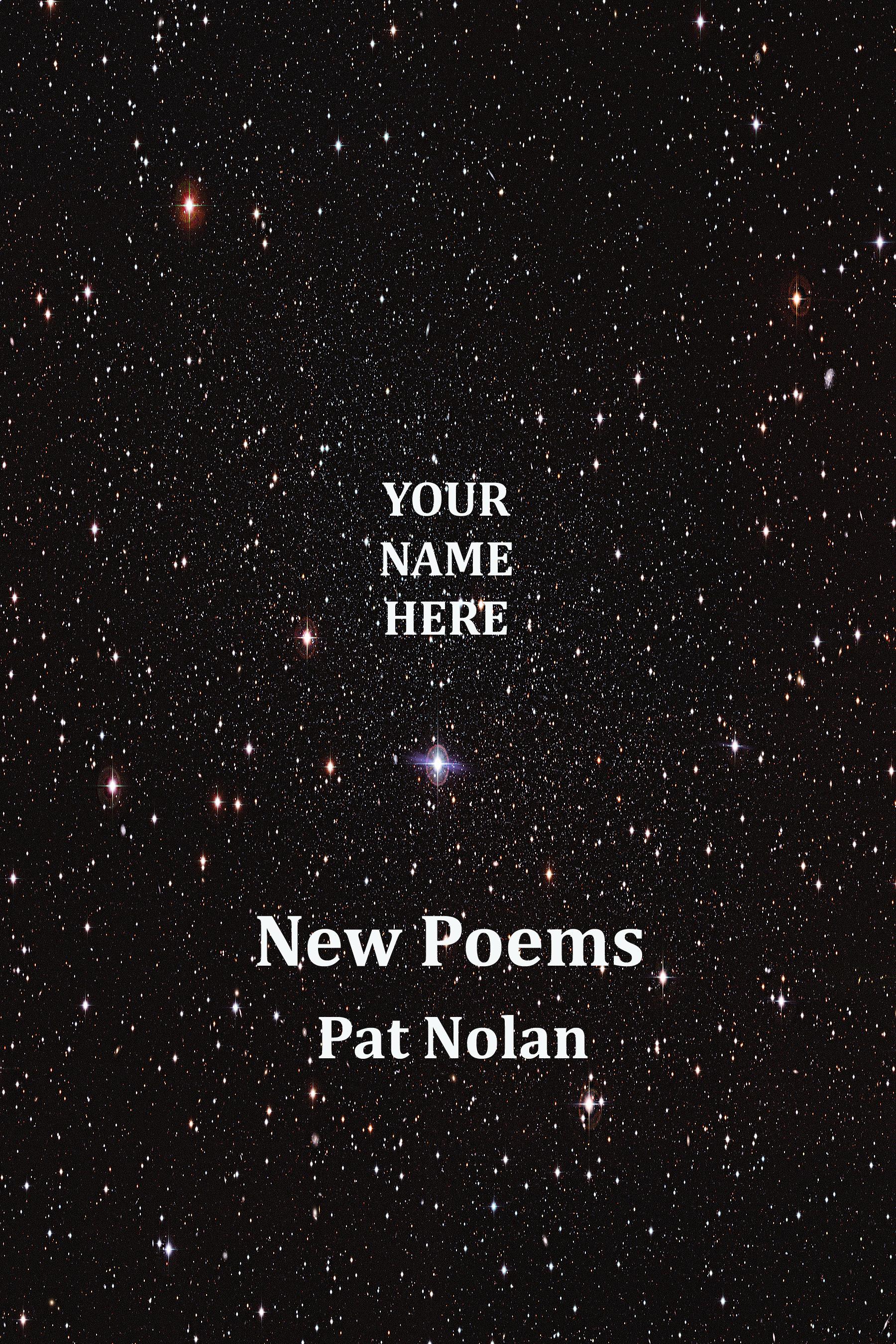
Never one to settle into a style, Pat Nolan has made of his poetry an exploration of other poetries and of the numerous ways a poem can be.  As an adherent of the Philip Whalen Buddhist-inspired “mind moving” school, he holds to the idea that the poem is framed sentience. Just as the observed world is an occasion of subjectivity, it also mirrors the self in a way that reflects objectively.  The poems in Your Name Here revolve around that quantum axis with seemingly random discontinuities that do not pin down meaning but are left to mean themselves.  Written to be heard by the mind’s ear, Nolan’s poetry enacts a sub-vocal monologue that is like the murmur of cosmic background radiation, noticeable only in its cessation or as pauses when the mind registers the sum of discrete moments in an instant.

November 2014 ~ 80 pages ~ $16 ~ paper ~ ISBN 978-0-9840310-0-9

Now available, click on How To Order on the menu bar to learn how.

Poet, translator, editor, publisher Pat Nolan is the author of over a dozen poetry selections and two novels.  He is the founder of Nualláin House, Publishers, and maintains The New Black Bart Poetry Society’s blog, Parole (thenewblackbartpoetrysociety.wordpress.com).  His work has been published in numerous national and international literary magazines and included in late 20th Century poetry anthologies and collections. He has recently begun posting his online serial novel, Ode To Sunset (odetosunset.com), about poets and poetry, death and dying. He lives along the lower Russian River in Northern California.


For readers in the North Bay latitudes of Northern California, join Pat Nolan for a publication party on November 9th.


Nualláin House, Publishers
&
Iota Press
invite you to

a publication party

Sunday Nov 9th
1:30 to 3:30 PM

for Pat Nolan’s
new book of poems

Your Name Here

at the Iota Press printery
925-D Gravenstein Hwy. South
Sebastopol CA
(behind  BeeKind)
Meet the author, book signing and sales,
refreshments in a convivial literary atmosphere
Caution: some poetry will be read


Your Name Here, Pre-Publication Offer

Order advance copies now and get free shipping!!

Your Name Here
New Poems

By Pat Nolan 

YNHcvrj

“The chief characteristic of the mind is to be consistently describing itself.”
− Henri Focillon (1881−1943)


Never one to settle into a style, Pat Nolan has made of his poetry an exploration of other poetries and of the numerous ways a poem can be.  As an adherent of the Philip Whalen Buddhist-inspired “mind moving” school, he holds to the idea that the poem is framed sentience. Just as the observed world is an occasion of subjectivity, it also mirrors the self in a way that reflects objectively.  The poems in Your Name Here revolve around that quantum axis with seemingly random discontinuities that do not pin down meaning but are left to mean themselves.  Written to be heard by the mind’s ear, Nolan’s poetry enacts a sub-vocal monologue that is like the murmur of cosmic background radiation, noticeable only in its cessation or as pauses when the mind registers the sum of discrete moments in an instant.

November 2014 ~ 80 pages ~ $16 ~ paper ~ ISBN 978-0-9840310-0-9


 Advance praise for Your Name Here 

“Pat Nolan is one of the poets, Ted Berrigan once said, that you have to always keep an eye on. . .because he can do unexpected startling things that leave you eating his dust.”
— Andrei Codrescu, author of Bibliodeath: My Archives (with Life in Footnotes), and So Recently Rent a World: New and Selected Poems, 1968-2012

“. . .Nolan’s secret power. . .engages us in magical transformation and will not let us look away.”
— Maureen Owen, author of Erosion’s Pull and Edges of Water     

Poet, translator, editor, publisher Pat Nolan is the author of over a dozen poetry selections and two novels.  He is the founder of Nualláin House, Publishers, and maintains The New Black Bart Poetry Society’s blog, Parole (thenewblackbartpoetrysociety.wordpress.com).  His work has been published in numerous national and international literary magazines and included in late 20th Century poetry anthologies and collections.  He lives along the lower Russian River in Northern California.

YOUR NAME HERE Preview

Your Name Here
New Poems

By Pat Nolan


“The chief characteristic of the mind is to be consistently describing itself.”
− Henri Focillon (1881−1943)

 
YNHcvrjNever one to settle into a style, Pat Nolan has made of his poetry an exploration of other poetries and of the numerous ways a poem can be. As an adherent of the Philip Whalen Buddhist-inspired “mind moving” school, he holds to the idea that the poem is framed sentience. Just as the observed world is an occasion of subjectivity, it also mirrors the self in a way that reflects objectively. The poems in Your Name Here revolve around that quantum axis with seemingly random discontinuities that do not pin down meaning but are left to mean themselves. Written to be heard by the mind’s ear, Nolan’s poetry enacts a sub-vocal monologue that is like the murmur of cosmic background radiation, noticeable only in its cessation or as pauses when the mind registers the sum of discrete moments in an instant.

November 2014 ~ 80 pages ~ $16 ~ paper ~ ISBN 978-0-9840310-0-9

 Preorder now and get free shipping
Click here for YOUR NAME HERE Preview


Advance praise for Your Name Here

Pat Nolan is one of the poets, Ted Berrigan once said, that you have to always keep an eye on. That’s not because he might suddenly win all the prizes the world owes you, but because he can do unexpected startling things that leave you eating his dust. Some poets are like that: they start slow and lazy as if life was enough, and then rev it up to some speed you thought only angels can get up to. Pat Nolan didn’t start slow, he started accurately, determined to be in the world without missing anything, not the wind in the trees, not the work of his contemporaries, not the changes of seasons or times. Like the Chinese poets Kenneth Rexroth translated, Nolan was always spare and articulate, attentive to beauty and impatient with sloppiness. Through the decades, his attention to nature, people, and his own observance of them, never wavered, but the onset of time, layer after imperceptible layer, kept adding meaning and sobriety to the clarity of his born-wise voice. What was once “irony,” which is that generous distance of youth regarding itself in the odd act of “seeing” and “scratching” words became an essential tool to survive as poet. Pat Nolan’s poetry has indeed survived, with the help of not just the luxury of irony, but also the blending of his secretly bilingual (French-Canadian and American) language, his intensely questioned, but never renounced, faith in poetry. His sense of wonder, sometimes wary and wise, often surprised, is always in and of the world around him, even when it flees playfully with the early heroes of French comic superheroes like Fantomas. Add to this work, the joyous and extensive reading of a profound autodidact with an active and sometimes polemical involvement in the “literary scenes” of the West and East coasts for better than half a century, and you have, standing suddenly in front of you, a poetry giant. I hope you’ve kept an eye on him, like I did, because with Your Name Here, he is indeed compelling all poets to put their name there. And when they do, amazing things happen. Go on, try it.

— Andrei Codrescu, author of Bibliodeath: My Archives (with Life in Footnotes), and So Recently Rent a World: New and Selected Poems, 1968-2012.


We hear in these works a kinship to that most glorious free spirit of the Tang Dynasty, Tu Fu. One can almost imagine Pat Nolan building himself a thatched hut and living the life of a farmer. Matching the light brush of that Master, Nolan’s painterly sensitivity unfolds a delicate beauty that breathtakingly fuses nature with a Surrealistic philosophic questioning and the meditative soul searching of a Sumi wash. Descriptions of nature so translucent we can only marvel how he weaves us into them, onward, around that eternal share of misfortune, bitter realization, and expectations gone wrong. This is Nolan’s secret power. He engages us in magical transformation and will not let us look away.

— Maureen Owen, author of Erosion’s Pull and Edges of Water


Poet, translator, editor, publisher Pat Nolan is the author of over a dozen poetry selections and two novels. He is the founder of Nualláin House, Publishers, and maintains The New Black Bart Poetry Society’s blog, Parole (thenewblackbartpoetrysociety.wordpress.com). His work has been published in numerous national and international literary magazines and included in late 20th Century poetry anthologies and collections. He lives along the lower Russian River in Northern California.


Your Name Here — New Poems by Pat Nolan

Coming this Fall

YNHfrtcv2j

Your Name Here
New Poems

By Pat Nolan


The chief characteristic of the mind is to be
consistently describing itself.”

                        − Henri Focillon (1881 – 1943)


Pre-order and get free shipping

November 2014 ~ $16 ~ paper ~ ISBN 978-0-9840310-0-9

Advance Praise for Your Name Here

Pat Nolan is one of the poets, Ted Berrigan once said, that you have to always keep an eye on. That’s not because he might suddenly win all the prizes the world owes you, but because he can do unexpected startling things that leave you eating his dust. Some poets are like that: they start slow and lazy as if life was enough, and then rev it up to some speed you thought only angels can get up to. Pat Nolan didn’t start slow, he started accurately, determined to be in the world without missing anything, not the wind in the trees, not the work of his contemporaries, not the changes of seasons or times. Like the Chinese poets Kenneth Rexroth translated, Nolan was always spare and articulate, attentive to beauty and impatient with sloppiness. Through the decades, his attention to nature, people, and his own observance of them, never wavered, but the onset of time, layer after imperceptible layer, kept adding meaning and sobriety to the clarity of his born-wise voice. What was once “irony,” which is that generous distance of youth regarding itself in the odd act of “seeing” and “scratching” words became an essential tool to survive as poet. Pat Nolan’s poetry has indeed survived, with the help of not just the luxury of irony, but also the blending of his secretly bilingual (French-Canadian and American) language, his intensely questioned, but never renounced, faith in poetry. His sense of wonder, sometimes wary and wise, often surprised, is always in and of the world around him, even when it flees playfully with the early heroes of French comic superheroes like Fantomas. Add to this work, the joyous and extensive reading of a profound autodidact with an active and sometimes polemical involvement in the “literary scenes” of the West and East coasts for better than half a century, and you have, standing suddenly in front of you, a poetry giant. I hope you’ve kept an eye on him, like I did, because with Your Name Here, he is indeed compelling all poets to put their name there. And when they do, amazing things happen. Go on, try it.
— Andrei Codrescu author of Bibliodeath: My Archives (with Life in Footnotes),  and So Recently Rent a World: New and Selected Poems, 1968-2012).

 We hear in these works a kinship to that most glorious free spirit of the Tang Dynasty, Tu Fu. One can almost imagine Pat Nolan building himself a thatched hut and living the life of a farmer. Matching the light brush of that Master, Nolan’s painterly sensitivity unfolds a delicate beauty that breathtakingly fuses nature with a Surrealistic philosophic questioning and the meditative soul searching of a Sumi wash. Descriptions of nature so translucent we can only marvel how he weaves us into them, onward, around that eternal share of misfortune, bitter realization, and expectations gone wrong. This is Nolan’s secret power. He engages us in magical transformation and will not let us look away.
— Maureen Owen, author of Erosion’s Pull and Edges of Water

Poet, translator, editor, publisher Pat Nolan is the author of over a dozen poetry selections and two novels. He is the founder of Nualláin House, Publishers, and maintains The New Black Bart Poetry Society’s blog, Parole. His work has been published in numerous national and international literary magazines and included in late 20th Century poetry anthologies and collections. He lives along the lower Russian River in Northern California.

Limited Edition: All Ears

All Ears

haikai no renga by Keith Kumasen Abbott, Pat Nolan, Maureen Owen & Michael Sowl

Renku PoetsAll Ears, a haikai no renga or linked verse, was the first of the collaborations between Maureen Owen, Keith Kumasen Abbott, Michael Sowl, and Pat Nolan to be made into a limited edition handmade book and was published by Empty Head Press in 2004.  Subsequently, Random Rocks and Poetry For Sale, both haikai no renga, were issued as limited edition handmade books(see Nualláin House archives for July 2013 and October 2012).  All Ears was also included in the anthology Saints of Hysteria, A Half Century of Collaborative American Poetry (Soft Skull Press, 2007).   

All Ears was composed through the mail over a period of a year and a half beginning in early 1992.  Once the 36 stanzas (kasen) of the haikai-no-renga were completed, each poet was asked to comment on the process in general, and on their own stanzas and those of their collaborators.  The arrangement of stanza follows the standard haikai form of 8 stanzas on the first sheet and 8 stanzas on the back sheet with the remaining 20 stanzas taking up the central text.  Following the haikai no renga and the commentary by the poets is the sequence showing the stanza assignment as well as which poets had the moon and flower stanzas.   

All Ears was bound using repurposed “sticks & strings” wallpaper sheets from a wallpaper sample book as cover stock and backed with Japanese silkscreen endpapers.  Each cover was unique in itself. The pages were folded vertically with a folded leading edge as is common in Japanese books.  Each book was hand sewn using a Japanese side stitch style known “tortoiseshell.”  The dimensions are 4.25×10 inches (10.5×16.5 cm).  Only a limited number of All Ears were produced and it is out of print. 

For more on the intriguing subject of Japanese Linked Verse, see Earl Miner’s Japanese Linked Poetry (Princeton, 1979), Hiroaki Sato’s One Hundred Frogs (Weatherhill, 1983), and Haruo Shirane’s Traces Of Dreams (Stanford, 1998).

To view a PDF facsimile of All Ears, click on ALL EARS 2004

Nualláin House So Far

HELLOLIFEjHello Life by Gail King
Poetry; The poems of Hello Life achieve their freshness in the particularity of experience. The poet surrenders herself to the moment and tenders that subtle cognition as a delighted welcome to life. The ease of her expression in dealing with the everyday communicates an uncommon wisdom. The poems present, through playful understatement and sly humor, the immediacy of spontaneous impressions. Maureen Owen, former artistic director for The Poetry Project in NYC and author of Edges of Water and Erosion’s Pull, says In Gail King’s poems the events of the day become transformative, the images of the temporary become immediate, and the mystery of being alive in the Now unfolds. “…time like a lake breeze” says the poet, and the wind rises.” Gail King’s poems have also won the praise of Andrei Codrescu, poet, novelist, essayist and NPR commentator, author of So Recent Rent A World, who said “Reading Gail King has always been one of my great poetry pleasures. Her inimitable voice narrates the world with humor and tenderness, a world of beauty and occasional sorrow. Her work has healing effects.”
December 2013  ~  $16.00  ~  64 pages ~ Paper  ~  ISBN 978-0-9840310-3-0


The Last ResortThe Last Resort, A Lee Malone Adventure by Pat Nolan
Meta Pulp– Pat Nolan has written a fast paced, tongue-in-cheek, pun filled comedy of errors, misunderstandings, and faux intuition in the mode of a 1930’s pulp thriller to talk about the pulp fiction of that era.  In doing so, The Last Resort presents an unlikely set of circumstances in which a worldly-wise female reporter must untangle herself from her past in order to deal with the puzzling events of her present.  Rather than the typical splinter-jawed, broken nosed, tobacco breathed tough guy hero, Nolan upends the stereotype by introducing a gorgeous internationally famous former fashion model whose super power is her beauty.  THE LAST RESORT, A Lee Malone Adventure, is a quirky, entertaining recreation of the lurid screed that once peopled pulp pages on newsstands everywhere.
August 2012 ~ $19.99 ~ 212 pages ~ Paper~ ISBN 978-0-9840310-2-3

“Has-been supermodel Lee Malone retains her drop-dead gorgeous looks—and haute couture wardrobe—and uses them every chance she gets to solve a murder mystery and live to write about it in The Last Resort: A Lee Malone Adventure. Author Pat Nolan sets this labyrinthine adventure in his home turf along the Russian River communities, renamed the Corkscrew River in the book. Having survived a botched kidnap attempt and a rescue by a secret female militia, Malone seeks the “quiet life” among the redwoods. She writes puff pieces for the Corkscrew County Grapevine, but stumbles into a deeper, more sinister story. Nolan weaves his heroine’s backstory throughout, touching on issues of homelessness, sex slavery, pornography and ever-changing relationships in river communities, while retaining a sense of humor and comic relief.”
— North Bay Bohemian, Fall Literary Issue, 2012


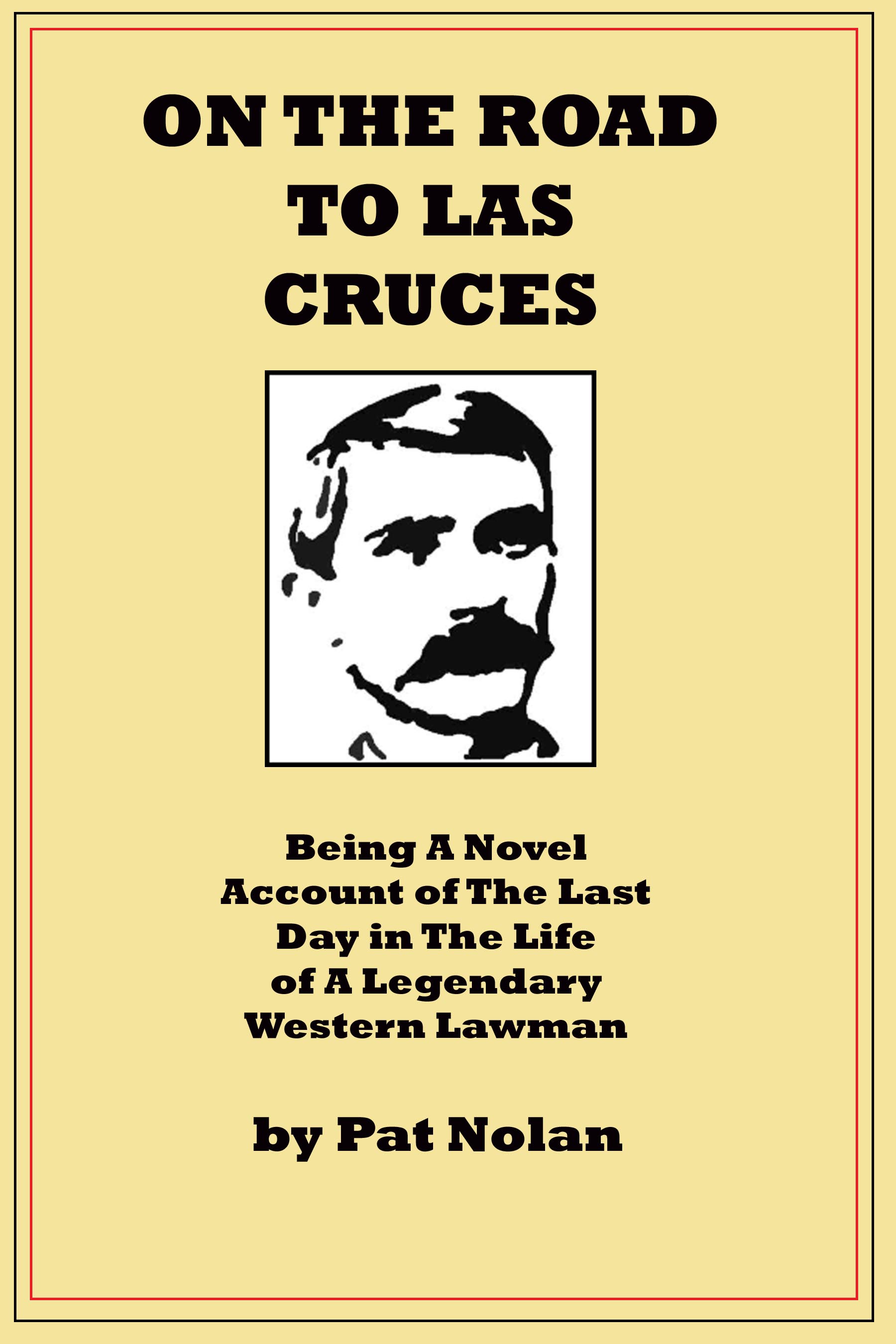
ontheroadfront300On The Road To Las Cruces, Being A Novel Account of The Last Day In The Life of A Legendary Western Lawman by Pat Nolan
Historical Fiction; On The Road To Las Cruces, a work of fiction tethered loosely to historical fact, is the story of the relationship between two men, one garrulous, the other taciturn, the Mutt and Jeff of the old Southwest.  What is related on the road to Las Cruces is as much a retelling of some history as it is how such a retelling might come about, and is represented in the manner of a tall tale, the deadpan details of a crime story, melodrama, and a conspiracy to murder. The road to Las Cruces is full of twists and turns.  The sound of a door slamming like a gunshot brings us into the world of the old Southwest and the gun violence of that historical era.  More than just the tale of a legendary lawman who remains nameless to the end, it is a lesson in storytelling and an allegory for how lives were lived and how death was dealt.  As much a dusty tale of buffalo hunts and shoot-outs as a politically driven “whodunit,” On The Road To Las Cruces is the story of youthful bravado and an old man’s regret.
November, 2011 ~ $16.99 ~ 154 pages ~ paper ~ ISBN 978-0-9840310-1-6

   “. . . a real old-fashioned Western. Page-turner. There are all sorts of funny sly mixes in the story, good Nolan humor, great repartee. . . .” – Andrei Codrescu, NPR commentator and author of Whatever Gets You Through The Night.                              

“Pat Nolan is not only one of our finest living poets. . . but now surprises with a prose paean to the West. Whatever Pat writes deserves to be read and remembered.” – Barry Gifford, author of Wild At Heart and Sailor And Lula


What is being said about Gail King

Gail King lives in a shed and has been getting away with murder for years.  This can be explained in part by quoting Hugh Kenner who said “American genius (in literature) cannot be distinguished by a casual glance from charlatanry. Purity of intention lies at the heart of American achievement.”  

Of her recent book of poems, Hello Life, Keith Kumasen Abbott, professor emeritus and author of numerous books of poetry, prose, and non-fiction, including Downstream from Trout Fishing In America, a Memoir, says In Hello Life Gail King often uses sleight of hand as she guides readers into a scene, a mood, a spiral, then disappears while events continue for us alone. Her art is beguiling, comic, candid and a pleasure.” 

Maureen Owen, former artistic director for The Poetry Project in NYC and author of many books of poems, including Edges of Water and Erosion’s Pull, says In Gail King’s poems the events of the day become transformative, the images of the temporary become immediate, and the mystery of being alive in the Now unfolds. “…time like a lake breeze” says the poet, and the wind rises.”

Gail King’s previous book of poems, Boxes & Chair (What Leaf Press, 2006) won the praise of Andrei Codrescu, poet, novelist, essayist and NPR commentator, author of So Recent Rent A World, who said “Reading Gail King has always been one of my great poetry pleasures. Her inimitable voice narrates the world with humor and tenderness, a world of beauty and occasional sorrow. Her work has healing effects.”

Joanne Kyger, author of more than twenty books of poetry and prose, including About Now: Collected Poems, and recipient of the 2008 PEN Oakland Josephine Miles National Literary Award for Poetry said of Boxes & Chairs “. . .a lovely lovely book. . .with direct beauty of what actually happens. [The poems] are all about SOMETHING, not just states of mind mired in ‘language’.”

Gail King, a Bay Area native, has lived in the Northern California town of Monte Rio for over 40 years. She has written poetry all her adult life and was the publisher of Doris Green Editions, a small literary press active in the ‘70’s and ‘80’s.  Boxes & Chairs, her third selection of poems, was published by What Leaf Press in 2006. Many of the poems featured in that selection are included in Hello Life.


HELLOLIFEj

December 2013  ~  $16.00  ~  64 pages ~ Paper  ~  ISBN 978-0-9840310-3-0

 now available from
Nualláin House, Publishers
Box 798 Monte Rio,California, 95462
(free shipping through December 31st, 2013)


Limited Edition: Random Rocks

Random Rocks

Haikai No Renga

By The Miner School of Haikai Poets

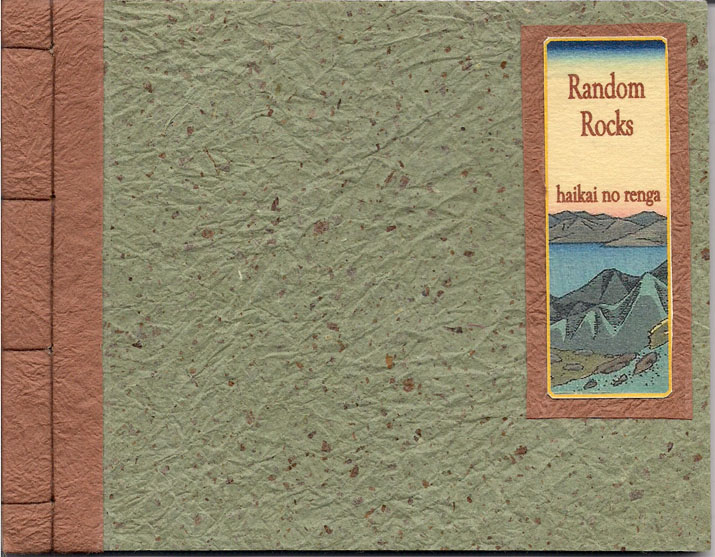
randrksfcRandom Rocks is a limited edition haikai no renga (linked verse) published by Bamboo Leaf Studio in 2007.  The size of the edition was linked to the number of stanzas in a kasen, a standard renga length employed by Basho and his disciples, and in the memorializing of the 36 immortal poets of Japanese literature.  Random Rocks measures 5.5x 7 (14x17cm), is hand sewn in the Japanese side stitch style, bound in heavy green chiri paper, momogami binding strips and features Japanese silk screen end papers.  The edition was divided evenly among the four haikai poets to distribute as they saw fit.                                                                                        

The Miner School of Haikai Poets have engaged in the practice of haikai no renga over a period of thirty years, written primarily through the mail and more recently, email.  They are Pat Nolan, Keith Kumasen Abbott, Michael Sowl and Maureen Owen. The Miner School’s haikai have been published in numerous magazine including Hanging Loose, Exquisite Corpse, Jack’s Magazine, Big Bridge, and Simply Haiku as well as in limited edition chapbooks and broadsides from Empty Head Press, Bamboo Leaf Studio, and Tangram Press.  Their kasen, All Ears, was included in Saints Of Hysteria, an anthology celebrating collaboration, from Soft Skull Press (2007).   

One of the unique features of Miner School haikai is that it includes a running commentary by the authors on each of their own stanzas as well as a stab at their collaborators’ links.  It functions in a way similar to commentary provided as a special features audio track on a DVD.  The introductory essay to another kasen, Bamboo Greeting, published in Simply Haiku (2008), further details some of the unconventional methods practiced by The Miner School of Haikai Poets.  

Haikai no renga is a form of renga (Japanese linked verse) practiced by Basho (1644-1694) and his disciples.  It consists of a 17 syllable verse and a 14 syllable verse provided in turn by the poets engaged in the collaboration.  In linking verses, a 31 syllable poem is produced, the latter verse of which (the 17 or the 14 syllable) will go on to join the next in the sequence to form its own unique poem, and so on until the requisite number of stanzas has been achieved.  Renga sequences can number into the hundreds.  Basho favored the economy of 36 stanzas.  Renku is diminutive for haikai no renga also known as haikai.  The more renowned Japanese verse form, haiku, is derived from the practice of amassing numerous hokku to vie for the privilege of opening a moon-viewing-sake-sipping evening of friendly literary collaborations.   Renga itself is derived from the courtly form of poetry exchanged by the aristocracy as exemplified in Lady Murasaki’s 11th Century The Tale Of Genji.  The rules of the composition for renga and haikai no renga are complicated and arcane, but like those of chess or go can be captivating and stimulating.  

For more on the intriguing subject of Japanese Linked Verse, see Earl Miner’s Japanese Linked Poetry (Princeton, 1979), Hiroaki Sato’s One Hundred Frogs (Weatherhill, 1983), and Haruo Shirane’s Traces Of Dreams (Stanford, 1998). 

A pdf facsimile of RandomRocks 2007can be found here.


Limited Edition: Poetry For Sale

Poetry For Sale

Haikai No Renga

By Keith Kumasen Abbott and Pat Nolan

Poetry For Sale is a limited edition haikai no renga (linked verse) published by Mountain Forest River Editions in 2008.  The size of the edition was linked to the number of stanzas in a kasen, a standard renga length employed by Basho and his disciples, and in the memorializing of the 36 immortal poets of Japanese literature; Poetry For Sale is also a kasen.   A variety of covers were printed (of which the accompanying image is only one of a half dozen) on 100% recycled Bogus Art paper and bound in the Yamato style using handmade ribbons of Japanese silkscreened paper.
Dimensions, w7 x h8 inches (18 x21.3 cm).
                                                                   

Keith Kumasen Abbott and Pat Nolan have engaged in the practice of haikai no renga over a period of thirty years.  They are founding members, along with Michael Sowl and Maureen Owen, of The Miner School of Haikai Poets. The Miner School’s haikai have been published in numerous magazine including Hanging Loose, Exquisite Corpse, Jack’s Magazine, Big Bridge, and Simply Haiku as well as limited edition chapbooks and broadsides from Empty Head Press, Bamboo Leaf Studio, and Tangram Press.  Their kasen, All Ears, was included in Saints Of Hysteria, an anthology celebrating collaboration, from Soft Skull Press (2007).  

One of the unique features of Miner School haikai is that it includes a running commentary by the authors on each of their own stanzas as well as a stab at their collaborators’ links.  It functions in a way similar to commentary provided as a special features audio track on a DVD.  In his introductory comment, Pat Nolan explains how the idea to write Poetry For Sale came about and how it would proceed:

I had been reading Earl Miner’s The Monkey’s Straw Raincoat for some clarification on an aspect of haikai and by chance reread his translation of the delightfully quirky haikai, Poetry Is What I Sell, written by Basho and Kikaku.  Miner speculated that the haikai might have even been used as a prospectus to garner new students.  I streamlined Miner’s version of the hokku and sent it off to my long time haikai partner Keith Kumasen Abbott with the idea of replicating the spirit of this haikai; he would be Basho and I would be Kikaku.  After some initial confusion, we followed the sequence that Miner set out in his introduction to this oddly hilarious renga

Haikai no renga is a form of renga (Japanese linked verse) practiced by Basho (1644-1694) and his disciples, one of whom was the above mentioned Kikaku (1661–1707).  It consists of a 17 syllable verse and a 14 syllable verse provided in turn by the poets engaged in the collaboration.  In linking verses, a 31 syllable poem is produced, the latter verse of which (the 17 or the 14 syllable) will go on to join the next in the sequence to form its own unique poem, and so on until the requisite number of stanzas has been achieved.  Renga sequences can number into the hundreds.  Basho favored the economy of 36 stanzas.  Renku is diminutive for haikai no renga also known as haikai.  The more renowned Japanese verse form, haiku, is derived from the practice of amassing numerous hokku to vie for the privilege of opening a moon-viewing- sake-sipping evening of friendly literary collaboration.   Renga itself is derived from the courtly form of poetry exchanged by the aristocracy as exemplified in Murasaki’s  11th Century The Tale Of Genji.  The rules of the composition for renga and haikai no renga are complicated and arcane, but like those of chess or go can be captivating and stimulating.

For more on the intriguing subject of Japanese Linked Verse, see Earl Miner’s Japanese Linked Poetry (Princeton, 1979) and Hiroaki Sato’s One Hundred Frogs (Weatherhill, 1983).  Also, the introductory essay to the kasen Bamboo Greeting, published in Simply Haiku (2008), further details some of the unconventional methods practiced by The Miner School of Haikai Poets. 

A pdf facsimile of Poetry For Sale can be found here.