Tag Archives: limited editions

Limited Edition: Poetry For Sale

Poetry For Sale

Haikai No Renga

By Keith Kumasen Abbott and Pat Nolan

Poetry For Sale is a limited edition haikai no renga (linked verse) published by Mountain Forest River Editions in 2008.  The size of the edition was linked to the number of stanzas in a kasen, a standard renga length employed by Basho and his disciples, and in the memorializing of the 36 immortal poets of Japanese literature; Poetry For Sale is also a kasen.   A variety of covers were printed (of which the accompanying image is only one of a half dozen) on 100% recycled Bogus Art paper and bound in the Yamato style using handmade ribbons of Japanese silkscreened paper.
Dimensions, w7 x h8 inches (18 x21.3 cm).
                                                                   

Keith Kumasen Abbott and Pat Nolan have engaged in the practice of haikai no renga over a period of thirty years.  They are founding members, along with Michael Sowl and Maureen Owen, of The Miner School of Haikai Poets. The Miner School’s haikai have been published in numerous magazine including Hanging Loose, Exquisite Corpse, Jack’s Magazine, Big Bridge, and Simply Haiku as well as limited edition chapbooks and broadsides from Empty Head Press, Bamboo Leaf Studio, and Tangram Press.  Their kasen, All Ears, was included in Saints Of Hysteria, an anthology celebrating collaboration, from Soft Skull Press (2007).  

One of the unique features of Miner School haikai is that it includes a running commentary by the authors on each of their own stanzas as well as a stab at their collaborators’ links.  It functions in a way similar to commentary provided as a special features audio track on a DVD.  In his introductory comment, Pat Nolan explains how the idea to write Poetry For Sale came about and how it would proceed:

I had been reading Earl Miner’s The Monkey’s Straw Raincoat for some clarification on an aspect of haikai and by chance reread his translation of the delightfully quirky haikai, Poetry Is What I Sell, written by Basho and Kikaku.  Miner speculated that the haikai might have even been used as a prospectus to garner new students.  I streamlined Miner’s version of the hokku and sent it off to my long time haikai partner Keith Kumasen Abbott with the idea of replicating the spirit of this haikai; he would be Basho and I would be Kikaku.  After some initial confusion, we followed the sequence that Miner set out in his introduction to this oddly hilarious renga

Haikai no renga is a form of renga (Japanese linked verse) practiced by Basho (1644-1694) and his disciples, one of whom was the above mentioned Kikaku (1661–1707).  It consists of a 17 syllable verse and a 14 syllable verse provided in turn by the poets engaged in the collaboration.  In linking verses, a 31 syllable poem is produced, the latter verse of which (the 17 or the 14 syllable) will go on to join the next in the sequence to form its own unique poem, and so on until the requisite number of stanzas has been achieved.  Renga sequences can number into the hundreds.  Basho favored the economy of 36 stanzas.  Renku is diminutive for haikai no renga also known as haikai.  The more renowned Japanese verse form, haiku, is derived from the practice of amassing numerous hokku to vie for the privilege of opening a moon-viewing- sake-sipping evening of friendly literary collaboration.   Renga itself is derived from the courtly form of poetry exchanged by the aristocracy as exemplified in Murasaki’s  11th Century The Tale Of Genji.  The rules of the composition for renga and haikai no renga are complicated and arcane, but like those of chess or go can be captivating and stimulating.

For more on the intriguing subject of Japanese Linked Verse, see Earl Miner’s Japanese Linked Poetry (Princeton, 1979) and Hiroaki Sato’s One Hundred Frogs (Weatherhill, 1983).  Also, the introductory essay to the kasen Bamboo Greeting, published in Simply Haiku (2008), further details some of the unconventional methods practiced by The Miner School of Haikai Poets. 

A pdf facsimile of Poetry For Sale can be found here.


Limited Edition: Thin Wings

THIN WINGS  − A Tanka Sequence

By Pat Nolan

Thin Wings was published in the Fall of 2005 by Empty Head Press in a limited edition lettered A through Z, signed by the author and bearing his seal, “wandering like a cloud,” each with a unique cover, some as reproductions of Japanese prints in the author’s collection, silk screened Japanese end papers, and hand sewn in the Japanese four-hole side stitch style.  It is made available here as a pdf file.

Tanka ,meaning ‘short song,’ is an unrhymed poem with a fixed thirty-one syllable pattern of 5-7-5-7-7.  In Westernized stanza form, it is a five line poem.   Tanka, one of the oldest of Japanese verse forms, dates back to before the 11th Century.  Tanka gained renewed popularity in the late 19th Century among radically modern young poets who brought its diction and subject matter up to date.  Historically, tanka is a precursor to renga, haikai, and haiku.  The poems in Thin Wings do not follow precisely the fixed syllabic count nor do they conform to many of the accepted tanka conventions but seek a synthesis and accommodation brought about by translation into a radically different language and culture.

From the introduction to Pat Nolan’s Cloud Scatter (Tangram Press, Berkeley, 1994)

Cloud Notes
Tanka originated as court poetry early in Japanese history. I would hesitate to call these poems tanka because that presumes a mastery of a complicated set of rules and conditions.  The poems. . .actually owe more to the intricate prosody of haikai no renga (known as renku or linked verse), than to this ancient form, especially in the relationship between [the split] stanzas.  There is, as a matter of fact, a renku term for a poem composed of only two links and that’s ‘tanrenga.’  As accurate as that may be, I am uneasy with that label.  ‘Tanku,’ a word of my own invention, would seem to accommodate the Japanese nomenclature (haiku, renku) but it too doesn’t suit my sense of these poems.  Ultimately, I find myself preferring tanka as the logical as well as sentimental favorite for what this kind of poem might be called.  I do so well aware that the designation is a borrowed one.

Limited Edition: Fly By Night

FLY BY NIGHT
Selected Poems, 1975 −1992
by Pat Nolan
 

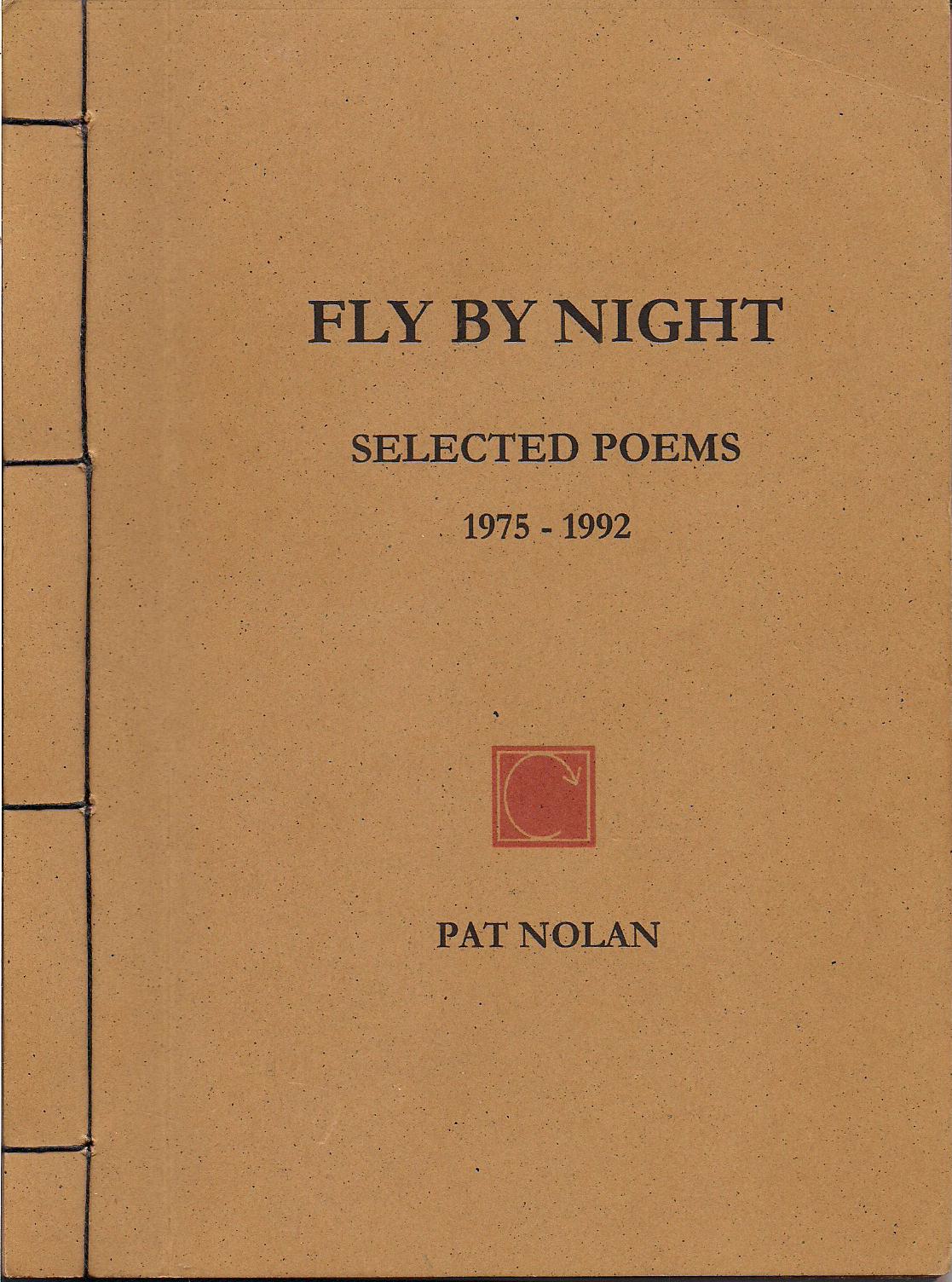
Doris Green Editions originally published Fly By Night as a limited edition specifically for the author’s readings at Naropa University in Boulder, Colorado and at The Poetry Project in New York City in November of 1992.  In 2006, Re:issue Press reprinted the selection of poems in the original edition adding the subheading Selected Poems, 1975 −1992. A few modest editorial changes were also made, and the biographical information updated.  Surplus covers from the original edition were recycled and cut down to fit the current format, from 8×10 to 5×7.  The hand-sewn Japanese style binding and the folded leading edge of the page are unique to the reissued edition.  A review of Fly By Night by Gabriel Ricard was published at the Unlikely Stories blog.  Here then is the full text of that 1992 selection of poems: Fly By Night Selected Poems 1975-1992

Terms, Conditions & Categories

Nualláin − (pronounced Noo-al-ayne) Celtic for the family name, Nolan, meaning noble or famous.  The Irish writer Brian O’Nualláin was also known as Brian O’Nolan, as well as by his most famous pseudonym, Flann O’Brien, author of At Swim-Two-Birds, The Third Policeman and The Dalkey Archives.
House – a business organization of like minded folk, kindred in their interest in the creative, bringing together years of experience in writing, self-publishing, book design, and book selling under one roof, peaked, in the shape of an open book (see logo on the masthead).
Publishers – a business or profession intent on making available literature of a particular genre, be it fiction, poetry or non-fiction, and often entered into more for personal satisfaction than financial gain.  The year 2011 marked the centennial of Brian O’Nualláin’s birth, a fitting beginning for Nualláin House, Publishers, and the publication of ON THE ROAD TO LAS CRUCES, A Novel Account of The Last Day In The Life of A Legendary Western Lawman by Pat Nolan (November, 2011).  Nualláin House, Publishers, will proceed on the assumption that what appeals to the editors might well appeal to other reasonably literate, intellectually curious readers.
Fiction – that which is made up, imaginatively, under the assumptions of possibility more than its probability irrespective of the truth; in short, fanciful lies.  Under the heading of fanciful lies, coming soon: THE LAST RESORT, A Lee Malone Adventure by Pat Nolan (August, 2012).
Poetry – the evil of banality.
Non-Fiction – not fiction.
Whimsy – capricious, eccentric, unpredictable and erratic (see Quirky).
Quirky – an abrupt twist or curve, idiosyncratic (see Whimsy).
Future – that which has the potential of occurring but has yet to occur and which will come to pass through the present however at a point in time yet to be determined.  Or to repurpose Rabelais’ last words, the “vast perhaps.”  Future titles from Nualláin House, Publishers in the crime fiction/ neo-pulp genre include BLACK MASK, A Detective Story, A GOOD LOOKING CORPSE, GONE MISSING, and PH FACTORAlso under the “vast perhaps” heading, selected, collected poems, and limited editions.  All titles will eventually be issued as eBooks.  Blog posts of reviews, interviews and commentary by noted authors will be a feature of the Nualláin House, Publishers site as well.
eBooks – at present, the eBook format taxes the technologically challenged and DIY mentality of Nualláin House, Publishers’ production designer.  Suffice it to say, all titles will eventually be issued as eBooks (see Future).  In the meantime, pdf files of sample chapters and limited edition poetry books will be made available on a regular basis with the compliments of Nualláin House, Publishers (see Future, Sample Chapters, and Limited Editions).
Comments – while this site encourages feedback, the comments feature has been disabled.  If readers wish to register feedback and/or commentary, their responses are more than welcome via email or snail mail (see Contact).
Manuscripts – unsolicited manuscripts are discouraged.
Contact – nuallainhousepublishers@gmail.com or Nualláin House, Publishers  Box 798 Monte Rio, CA 95462
Sample Chapters – sample chapters will be available as posts and as a feature of that title’s page.
Expectations – Great.  However, many years of experience in the literary world (see House) has demonstrated the need for caution in this category.
FacebookNualláin House, Publishers has a Facebook page.  Tell your Facebook friends.
Limited Editions – In the months to come (see Future), Nualláin House, Publishers will make available pdf files of rare and limited editions of poetry books from such presses as Re:Issue Press, On The Fly Press, Last Cookie Press, Editions de Jacob, Bamboo Studio, Empty Head Press, Egret Moon, and Not My Hat Press featuring such titles as Fly By Night, Later, Carbon Data, Intellectual Pretensions, Thin Wings, Untouched By Rain, Ah Bolinas!, Exile In Paradise, and Jacks Or Better.
POS – the Nualláin House, Publishers site remains the primary point of sale.  Titles are available at their advertised price plus $5 shipping & handling.  Institutional, bookstore, and cash discounts are available upon inquiry.  Orders can be placed through email or via the postal address (see Contact).  Make checks or money orders payable to ‘Pat Nolan.’
Copyright – all material on the Nualláin House, Publishers site is copyright © byNualláin House, Publishers or by its specific authors and may not be used or reproduced without the express permission of the copyright holder.