Tag Archives: limited editions

Limited Edition: So Remote The Mountains

So Remote The Mountains
after Saigyo

by Pat Nolan


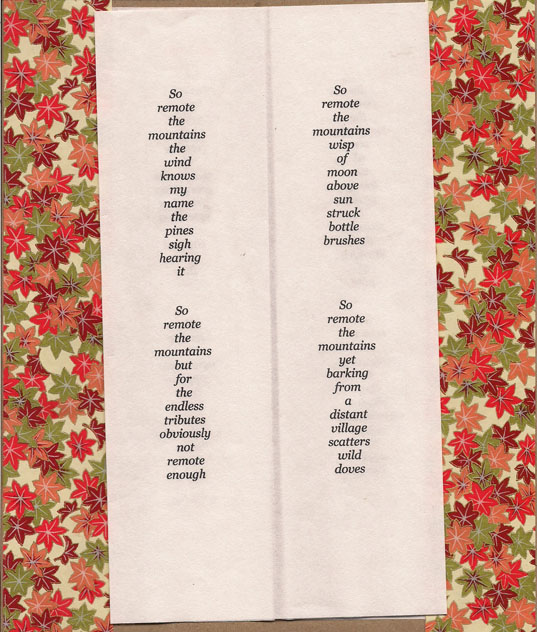
so remote cvr So Remote The Mountains is a limited edition fanfold featuring twelve meditations on Saigyo’s tanka, yama fukami (So remote the mountains). A Buddhist monk-poet, Saigyo (1118 – 1190) is one of the most well known and influential of the traditional Japanese poets writing in waka, or tanka, the court poetry style of the late Heian, early Kamakura era. Saigyo had written ten tanka that began with the phrase yama fukami describing the austere and remote circumstances of his hermitage near Mount Koya and sent them to a fellow monk who lived some distance away, north of Kyoto. With a few exceptions, all of Saigyo’s poems are written in the 31 syllable form of tanka or waka favored by the Japanese court of his day. The tanka is a precursor to renga and hiakai no renga (linked verse) and today’s popular haiku. Its 31 syllables are generally broken into sets of 5-7-5-7-7 syllables from which traditional haiku derives its 17 syllable format.

            The twelve meditations on Saigyo’s So Remote The Mountain by Pat Nolan are not tanka, nor are they technically haiku as they do not adhere to the syllabic count for either of these forms. They are probably closer to haiku than tanka because of their succinctness. However it is best to think of them as call and response. The call is Saigyo’s line yama fukami, and the response is the meditation on the line, sometimes sober, sometimes humorous, all of which emphasize a sense of isolation and distance.

            This limited edition of So Remote The Mountain is a fanfold printed on rough unbleached mulberry paper set in a cover of 100% recycled Bogus art paper with Japanese silk screened endpapers imported from Kyoto. The cover is an original stencil print by the author. Each is numbered, signed, with the author’s seal. The fanfold measures 3-11/16th x 8-7/8th inches (9.5×22.5 cm) closed, 7-3/8th x8-7/8th inches (19.3×22.5 cm) open.  Japanese silk screened endpapers can vary from what is shown.  However all endpapers are genuine Japanese silk screened paper.
so remote intext


So Remote the Mountain is available from Nualláin House, Publishers Box 798, Monte Rio, CA 95462, for $10 (postage included) cash, check or money order (make check or MO payable to ‘Pat Nolan’).

 

Smoking Poets


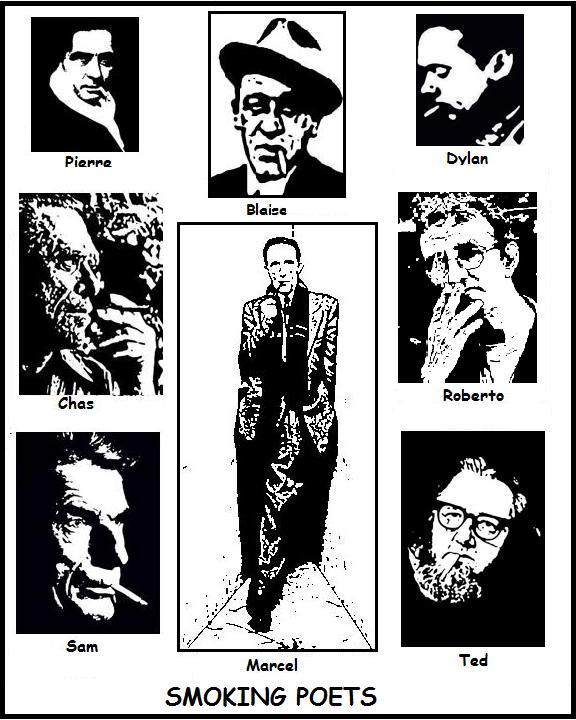
bambooleafchopNualláin House, Publishers, in partnership with Bamboo Leaf Studio, is offering limited edition linoleum prints of Smoking Poets, an ongoing series of author prints by Pat Nolan. The smoking poets in this in series include Blaise Cendrars, Pierre Reverdy, Dylan Thomas, Samuel Beckett, Ted Berrigan, Charles Bukowski, Roberto Bolaño, and the muse of amusement, Marcel Duchamp.


The Smoking Poets

duchampstmpgrp1Blaise Cendrars, edition of 50, 5×7” (12.7×17.78 cm) printed on unbleached mulberry paper, $30 US each


duchampstmpgrp3

Samuel Beckett, edition of 50, 5×7” (12.7×17.78 cm) printed on unbleached mulberry paper, $30 US each


duchampstmpgrp5

Pierre Reverdy, edition of 50, 4×5” (10.16×12.7 cm) printed on unbleached mulberry paper, $25 US each


duchampstmpgrp4

Dylan Thomas, edition of 50, 4×5” (10.16×12.7 cm) printed on unbleached mulberry paper, $25 US each


duchampstmpgrp8

Ted Berrigan, edition of 50, 5×7” (12.7×17.78 cm) printed on unbleached mulberry paper, $30 US each


duchampstmpgrp2

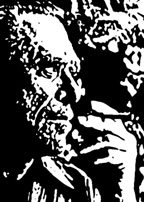
Charles Bukowski, edition of 50, 5×7” (12.7×17.78 cm) printed on unbleached mulberry paper, $30 US each


duchampstmpgrp6

Roberto Bolaño, edition of 50, 5×7” (12.7×17.78 cm) printed on unbleached mulberry paper, $30 US each


duchampstmpgrp

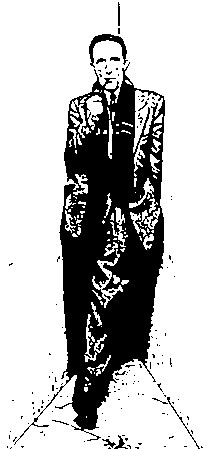
Marcel Duchamp, edition of 50, 8×10 (20.32×25.4 cm) printed on unbleached mulberry paper, $40 US each


How To Order: Send check, money order, or cash to Nualláin House, Publishers Box 798 Monte Rio, CA 95462. Include $5 shipping for single prints. Purchase more than one print and receive free shipping. Make checks and money orders payable to ‘Pat Nolan.’
Special offer: purchase all the Smoking Poets and receive the Marcel Duchamp print free, compliments of Bamboo Leaf Studio.


Artist’s Statement:   

I first came to print making through an avid interest in Ukiyo-e prints, in the process amassing a large number of monographs, museum catalogs, and anthology representations of floating world artists who were popular in Japan in the 18th to the late 19th century. The subdued palette of basic colors reminded me of the color funny papers and comic books that were a consuming interest when I was a youngster. The more I learned about the art of Japanese print making, the more I came to appreciate 20th Century artists and the powerful simplicity of black and white prints in the hands of masters like Munakata, Unichi, and Okuyama. My by-now obsession with Japanese prints was kicked up a notch when I began collecting affordable reproductions of the Edo masters as well as original work by contemporary artists. The next level was to try my hand at making prints of my own. I had better luck carving linoleum blocks than I did wood and took the path of least resistance. I knew I wanted to work with and/or adapt the Japanese motifs I was familiar with. I had the idea of making Buddhist inspired prints featuring original homilies (“Kicked a clump of dirt – my return address”) since some of the earliest Japanese prints were devotional prints sold to pilgrims traveling to various shrines and temples. I also wanted to attempt portraits of literary personages, poets primarily, in the manner of Kabuki actor prints. My emphasis is black and white, printing with water soluble ink on mulberry paper, and, in most instances, letting the uncarved portions of the block define the picture plane. The blocks are printed by hand using a variety of barens and multiple inkings.

The Smoking Poets idea came to me after I had completed the Samuel Beckett print. As the idea took shape and I searched for images of poets smoking, I visualized it as an on-going series with the muse of amusement, Marcel Duchamp, as the centerpiece of this modern literary conclave.

Pat Nolan, Monte Rio, 6/1/2014

duchampstmpgrport


Limited Edition: Lyre Liar


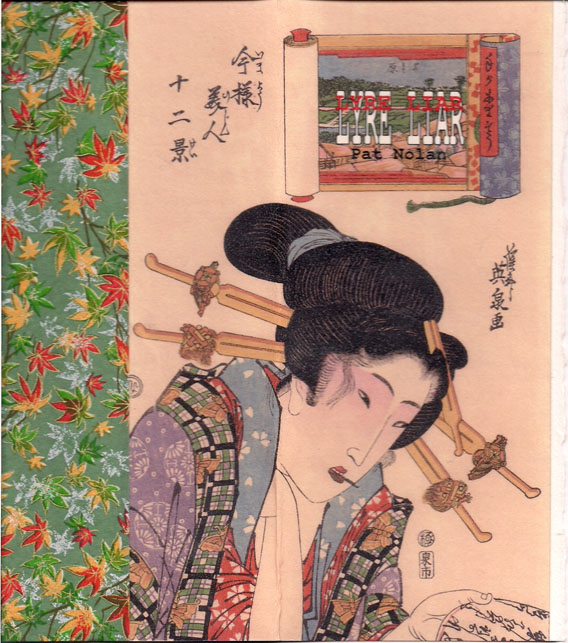
lyreliarcvrfLyre Liar,
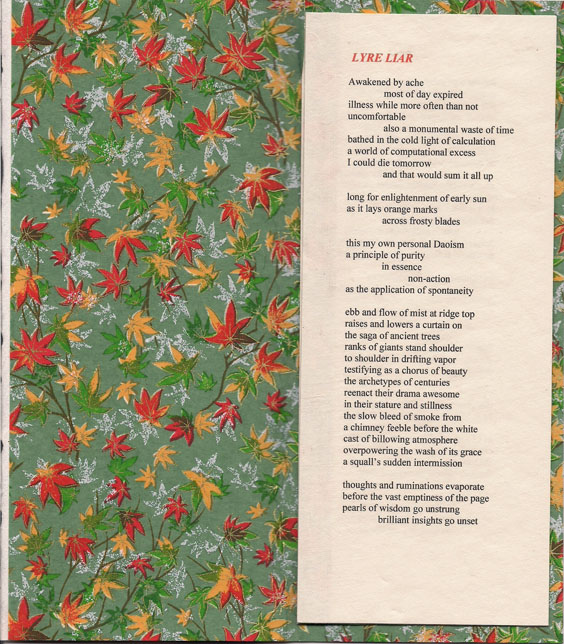
a poem by Pat Nolan, was published by Bamboo Leaf Studio in 2012 in a limited numbered edition of 12 signed by the author with his seal. The cover is printed on a heavy weight Reeves print paper and folded as a clamshell as the platform for the fanfold poem. A band of washi with the author’s seal secures the clamshell closed. The endpapers are Japanese silkscreened patterns imported from Kyoto. Lyre Liar measures 9×7.75 inches (22.7×19.6 cm) open and 9×3 7/8 inches (22.7×9.8cm) closed. The fanfold poem is printed on an unbleached washi and measures 9×20.5 inches (22.7×52 cm) fully extended. Lyre Liar is out of print in this edition.


lyreliaropenlyreliartxt


Click LYRE LIAR 2012 to view a pdf facsimile.

Limited Edition: Carved In Stone

carvedcvrf
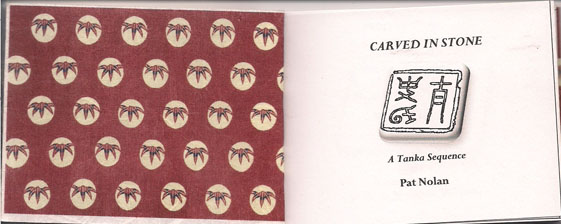
Carved In Stone, a tanka sequence by Pat Nolan, was published by Empty Head Press in the Summer of 2013 in a limited numbered edition signed by the author with his seal.  The covers are printed on heavy weight dragon cloud washi featuring reproductions of one of four Japanese prints from the series Imayo sugata (Stylish Appearances) as are the bamboo leaf endpapers.  Carved In Stone measures 4.25×3 inches (10.7×7.8 cm) and is bound in the Yamato style binding.  The 26 text pages (including 5 illustration) are printed on recycled paper.
 carvedend

Tanka ,meaning ‘short song,’ is an unrhymed poem with a fixed thirty-one syllable pattern of 5-7-5-7-7.  In Westernized stanza form, it is a five line poem.   Tanka, one of the oldest of Japanese verse forms, dates back to before the 11th Century.  Tanka gained renewed popularity in the late 19th Century among radically modern young poets who brought its diction and subject matter up to date.  Historically, tanka is a precursor to renga, haikai, and haiku.
   carvedpem2                                 

The poems in Carved In Stone do not follow precisely the fixed syllabic count nor do they conform to many of the accepted tanka conventions but seek a synthesis and accommodation brought about by translation into a radically different language and culture.

carvedcvrb
A few copies of Carved In Stone are still available from the publisher for $20 each plus shipping.  See How To Order for more information.

Limited Edition: All Ears

All Ears

haikai no renga by Keith Kumasen Abbott, Pat Nolan, Maureen Owen & Michael Sowl

Renku PoetsAll Ears, a haikai no renga or linked verse, was the first of the collaborations between Maureen Owen, Keith Kumasen Abbott, Michael Sowl, and Pat Nolan to be made into a limited edition handmade book and was published by Empty Head Press in 2004.  Subsequently, Random Rocks and Poetry For Sale, both haikai no renga, were issued as limited edition handmade books(see Nualláin House archives for July 2013 and October 2012).  All Ears was also included in the anthology Saints of Hysteria, A Half Century of Collaborative American Poetry (Soft Skull Press, 2007).   

All Ears was composed through the mail over a period of a year and a half beginning in early 1992.  Once the 36 stanzas (kasen) of the haikai-no-renga were completed, each poet was asked to comment on the process in general, and on their own stanzas and those of their collaborators.  The arrangement of stanza follows the standard haikai form of 8 stanzas on the first sheet and 8 stanzas on the back sheet with the remaining 20 stanzas taking up the central text.  Following the haikai no renga and the commentary by the poets is the sequence showing the stanza assignment as well as which poets had the moon and flower stanzas.   

All Ears was bound using repurposed “sticks & strings” wallpaper sheets from a wallpaper sample book as cover stock and backed with Japanese silkscreen endpapers.  Each cover was unique in itself. The pages were folded vertically with a folded leading edge as is common in Japanese books.  Each book was hand sewn using a Japanese side stitch style known “tortoiseshell.”  The dimensions are 4.25×10 inches (10.5×16.5 cm).  Only a limited number of All Ears were produced and it is out of print. 

For more on the intriguing subject of Japanese Linked Verse, see Earl Miner’s Japanese Linked Poetry (Princeton, 1979), Hiroaki Sato’s One Hundred Frogs (Weatherhill, 1983), and Haruo Shirane’s Traces Of Dreams (Stanford, 1998).

To view a PDF facsimile of All Ears, click on ALL EARS 2004

Special Offer: Cloud Traffic

cloud traffic

Special Offer

Limited Edition Broadside

Cloud Traffic

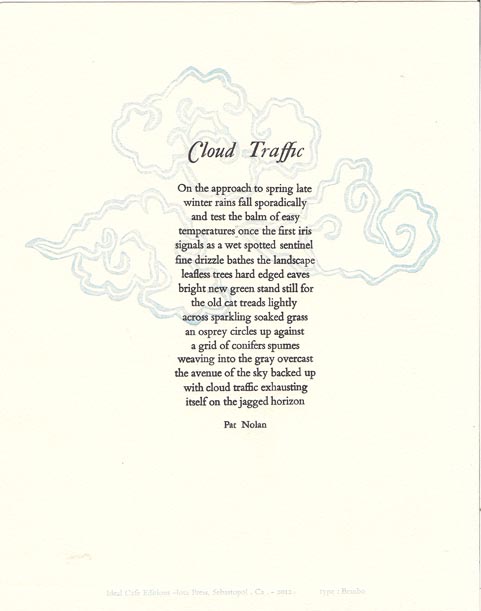
A poem and linoleum cut by Pat Nolan in a signed and numbered edition of fifty, printed in Bembo by Luci Edwards on Arches Text  (6 5/8 x 8 3/4 in.; 16.9 x 22.3 cm) from Ideal Café Editions at Iota Press Sebastopol, CA available now for $10 each, postage included, for a limited time only through Nualláin House, Publishers.  See How To Order for more information.

Limited Edition: Carbon Data

Carbon Data

By Pat Nolan


carbon dataCarbon Data is a limited edition poetry selection published by Last Cookie Press in 2008, bound with 60# granite grey cover stock in the Japanese four-hole style.  35 pages, 8.5×5.5 

The poems in Carbon Data first appeared in Fell Swoop, Tight, Exquisite Corpse, Smelt Money, Kickass Review, Watching The Wheels: A Blackbird, Court Green, and Otolith as well as in volumes of selected poetry including Fly By Night (1992), The Nolan Anthology Of Poetry, Vol. II (2003), and Later (2007).  

Pat Nolan’s poetry and prose have been published in numerous magazines including Rolling Stone, The Paris Review, The World, Big Bridge, Poetry Flash, and Exquisite Corpse as well as literary magazines in Europe and Asia.  He is the author of fifteen books of poetry, including LATER from On The Fly Press (2007).  

This limited edition is still available for $10 plus shipping.  Get free shipping when you purchase a copy of either On The Road to Las Cruces or The Last Resort along with Carbon Data.  Click here to preview a pdf facsimile of  CARBON DATA 2008

Limited Edition: Random Rocks

Random Rocks

Haikai No Renga

By The Miner School of Haikai Poets

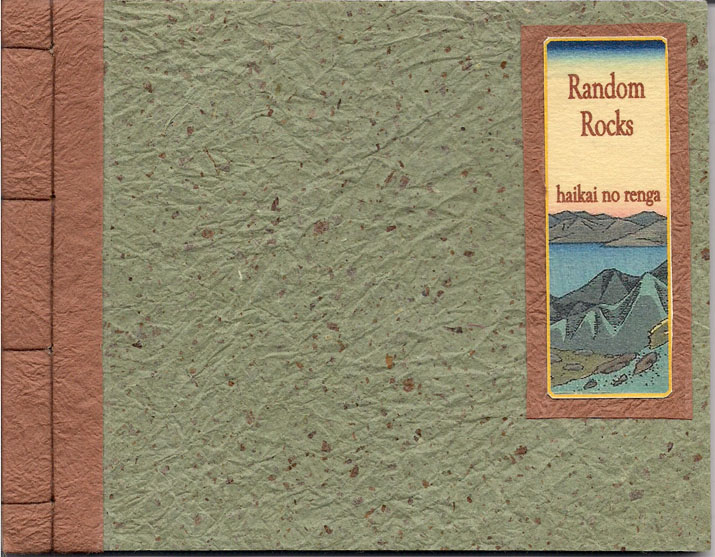
randrksfcRandom Rocks is a limited edition haikai no renga (linked verse) published by Bamboo Leaf Studio in 2007.  The size of the edition was linked to the number of stanzas in a kasen, a standard renga length employed by Basho and his disciples, and in the memorializing of the 36 immortal poets of Japanese literature.  Random Rocks measures 5.5x 7 (14x17cm), is hand sewn in the Japanese side stitch style, bound in heavy green chiri paper, momogami binding strips and features Japanese silk screen end papers.  The edition was divided evenly among the four haikai poets to distribute as they saw fit.                                                                                        

The Miner School of Haikai Poets have engaged in the practice of haikai no renga over a period of thirty years, written primarily through the mail and more recently, email.  They are Pat Nolan, Keith Kumasen Abbott, Michael Sowl and Maureen Owen. The Miner School’s haikai have been published in numerous magazine including Hanging Loose, Exquisite Corpse, Jack’s Magazine, Big Bridge, and Simply Haiku as well as in limited edition chapbooks and broadsides from Empty Head Press, Bamboo Leaf Studio, and Tangram Press.  Their kasen, All Ears, was included in Saints Of Hysteria, an anthology celebrating collaboration, from Soft Skull Press (2007).   

One of the unique features of Miner School haikai is that it includes a running commentary by the authors on each of their own stanzas as well as a stab at their collaborators’ links.  It functions in a way similar to commentary provided as a special features audio track on a DVD.  The introductory essay to another kasen, Bamboo Greeting, published in Simply Haiku (2008), further details some of the unconventional methods practiced by The Miner School of Haikai Poets.  

Haikai no renga is a form of renga (Japanese linked verse) practiced by Basho (1644-1694) and his disciples.  It consists of a 17 syllable verse and a 14 syllable verse provided in turn by the poets engaged in the collaboration.  In linking verses, a 31 syllable poem is produced, the latter verse of which (the 17 or the 14 syllable) will go on to join the next in the sequence to form its own unique poem, and so on until the requisite number of stanzas has been achieved.  Renga sequences can number into the hundreds.  Basho favored the economy of 36 stanzas.  Renku is diminutive for haikai no renga also known as haikai.  The more renowned Japanese verse form, haiku, is derived from the practice of amassing numerous hokku to vie for the privilege of opening a moon-viewing-sake-sipping evening of friendly literary collaborations.   Renga itself is derived from the courtly form of poetry exchanged by the aristocracy as exemplified in Lady Murasaki’s 11th Century The Tale Of Genji.  The rules of the composition for renga and haikai no renga are complicated and arcane, but like those of chess or go can be captivating and stimulating.  

For more on the intriguing subject of Japanese Linked Verse, see Earl Miner’s Japanese Linked Poetry (Princeton, 1979), Hiroaki Sato’s One Hundred Frogs (Weatherhill, 1983), and Haruo Shirane’s Traces Of Dreams (Stanford, 1998). 

A pdf facsimile of RandomRocks 2007can be found here.


Limited Edition: Untouched By Rain

Untouched By Rain

A Tanka Sequence

by Pat Nolan 

ubrfcvrUntouched By Rain was published in 2005 by Empty Head Press in a limited edition, lettered A through Z, signed by the author and bearing his seal, “old goat.” Each hand-made book has a unique cover, many as reproductions of  uchiwa-e, Japanese fan prints, features silk screened Japanese end papers, and is hand sewn in the Japanese four-hole side stitch binding.  The black & white illustrations accompanying the tanka represent traditional Japanese motifs such as the cherry blossom, crane, bamboo, and pine. Untouched By Rain, and a companion selection of tanka, Thin Wings, were originally made to be sold through the gift shop at the Sonoma County Museum.  Up until the gallery’s recent closing, both tanka selections were also offered through The Quicksilver Mine Company.  Less than a handful of copies of Untouched By Rain are still available.  Inquiries welcome.

presentation envelope

Click to view a pdf facsimile of Untouched By Rain 2005

Tanka, meaning ‘short song,’ is an unrhymed poem with a fixed thirty-one syllable pattern of 5-7-5-7-7.  In Westernized stanza form, it is a five line poem.   Tanka, one of the oldest of Japanese verse forms, dates back to before the 11th Century.  Tanka gained renewed popularity in the late 19th Century among radically modern young poets who brought its diction and subject matter up to date.  Historically, tanka is a precursor to renga, haikai, and haiku.  The poems in Untouched By Rain do not follow precisely the fixed syllabic count nor do they conform to many of the accepted tanka conventions but seek a synthesis and accommodation brought about by translation into a radically different language and culture. 

Limited Edition: Boxes & Chairs

Boxes & Chairs

By Gail King

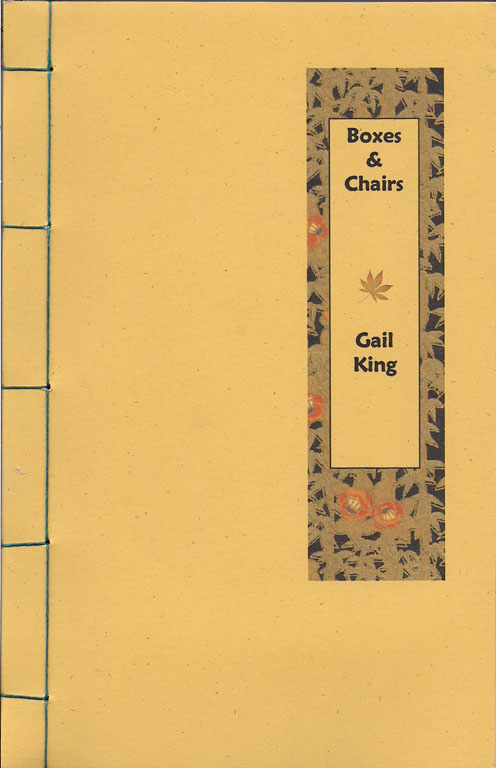
BCFBoxes & Chairs was originally published in 2006 as a handmade limited gift edition of twenty five for family and friends. The covers were printed on heavy weight Reeves print stock with Japanese silkscreen end papers and binding strips. The book was bound in the traditional Japanese four-hole binding style. Illustrations accompanying the poems are reproductions of kuchi-e, woodblock prints that were used to illustrate short stories in Meiji era magazines and journals of late 19th Century Japan.

Subsequently an unlimited ‘people’s’ edition was issued with a plain cover but with the original text and illustrations intact.

People's Edition
People’s Edition

Gail King has been active in writing and publishing in the Russian River area since the mid 70’s. A Northern California native, she writes stories of growing up in the East Bay (Oakland/ San Leandro) as well as poetry focusing on the California landscape. She was the publisher of Doris Green Editions, a small literary press active in the ‘70’s and ‘80’s. Boxes & Chairs, published by What Leaf Press, is her second collection of poems. A more comprehensive selection of her poems is slated for publication by Nualláin House, Publishers, in the Fall of 2013 which will include the entirety of Boxes & Chairs.

Praise for Boxes & Chairs:

“Gail King’s poems celebrate the change and deep pleasures in tracking transformation. With a sinuous and penetrating wit King remembers her life via alarm, humor and love: a night ago the wind/ and rain let us in on a secret/ our forts are temporary/ no rest inside the box.”
— Keith Kumasen Abbott

“Reading Gail King has always been one of my great poetry pleasures. Her inimitable voice narrates the world with humor and tenderness, a world of beauty and occasional sorrow. Her work has healing effects.”
— Andrei Codrescu

“. . .a lovely lovely book. . .with direct beauty of what actually happens. [The poems] are all about SOMETHING, not just states of mind mired in ‘language’.”
— Joanne Kyger

Click to view a pdf facsimile of the limited gift edition of  Boxes & Chairs