Category Archives: Limited Editions

Limited Edition: Jacks Or Better

Jacks Or Better

by Pat Nolan

Jacks Or Better is a travel journal (kikobun) in the tradition of Basho’s Narrow Roads To Far Off Places.  The narrow road followed in this journal is the iron road, from San Francisco to rural Florida with stops in New Orleans and Baton Rouge.  It is a poet’s journey expressed as haibun in which descriptive or expressionistic prose is capped by a haiku-like poem that continues the thread, elucidates it, or offers a disparate juxtaposition.  Published by Egret Moon Press in 2011 in a limited edition of 36 copies. 38 pages hand-bound with Japanese stitching between grey repurposed paper covers, 7×7.25 inches (18x19cm).


jobfcvrfrom Jacks Or Better 

Although this is my first trip to New Orleans, I’ve taken trains across country before and have always found that if you’re on a schedule they are the last place to be.  But if you’re not in a hurry, they enforce a leisurely pace that is fast becoming antique. My final destination is Florida where I will visit with my parents.  The first leg will take most of three days. This trip is ostensibly about the anatomy of a friendship and the relationship between generations.  I will visit with Andrei Codrescu in New Orleans and lecture to his MA classes at Louisiana State University. 

Baton Rouge
“only place in America named
         after a dog’s dick”


 To view a pdf facsimile click JACKS OR BETTER 2011

Limited Edition: Carbon Data

Carbon Data

By Pat Nolan


carbon dataCarbon Data is a limited edition poetry selection published by Last Cookie Press in 2008, bound with 60# granite grey cover stock in the Japanese four-hole style.  35 pages, 8.5×5.5 

The poems in Carbon Data first appeared in Fell Swoop, Tight, Exquisite Corpse, Smelt Money, Kickass Review, Watching The Wheels: A Blackbird, Court Green, and Otolith as well as in volumes of selected poetry including Fly By Night (1992), The Nolan Anthology Of Poetry, Vol. II (2003), and Later (2007).  

Pat Nolan’s poetry and prose have been published in numerous magazines including Rolling Stone, The Paris Review, The World, Big Bridge, Poetry Flash, and Exquisite Corpse as well as literary magazines in Europe and Asia.  He is the author of fifteen books of poetry, including LATER from On The Fly Press (2007).  

This limited edition is still available for $10 plus shipping.  Get free shipping when you purchase a copy of either On The Road to Las Cruces or The Last Resort along with Carbon Data.  Click here to preview a pdf facsimile of  CARBON DATA 2008

Limited Edition: Random Rocks

Random Rocks

Haikai No Renga

By The Miner School of Haikai Poets

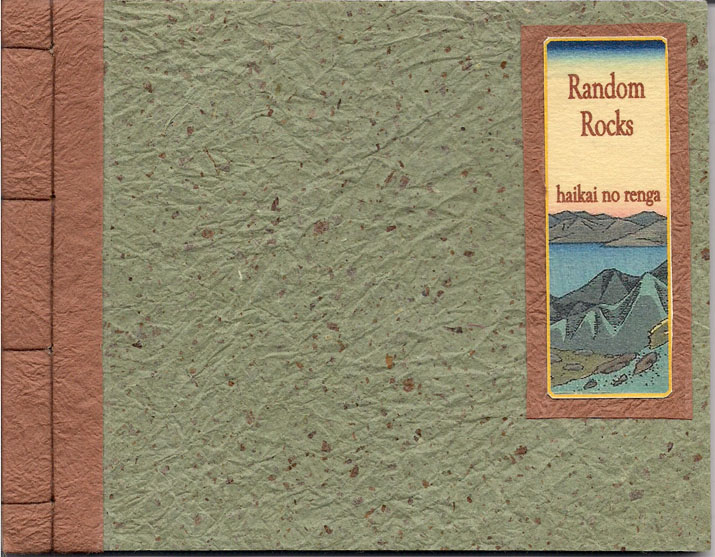
randrksfcRandom Rocks is a limited edition haikai no renga (linked verse) published by Bamboo Leaf Studio in 2007.  The size of the edition was linked to the number of stanzas in a kasen, a standard renga length employed by Basho and his disciples, and in the memorializing of the 36 immortal poets of Japanese literature.  Random Rocks measures 5.5x 7 (14x17cm), is hand sewn in the Japanese side stitch style, bound in heavy green chiri paper, momogami binding strips and features Japanese silk screen end papers.  The edition was divided evenly among the four haikai poets to distribute as they saw fit.                                                                                        

The Miner School of Haikai Poets have engaged in the practice of haikai no renga over a period of thirty years, written primarily through the mail and more recently, email.  They are Pat Nolan, Keith Kumasen Abbott, Michael Sowl and Maureen Owen. The Miner School’s haikai have been published in numerous magazine including Hanging Loose, Exquisite Corpse, Jack’s Magazine, Big Bridge, and Simply Haiku as well as in limited edition chapbooks and broadsides from Empty Head Press, Bamboo Leaf Studio, and Tangram Press.  Their kasen, All Ears, was included in Saints Of Hysteria, an anthology celebrating collaboration, from Soft Skull Press (2007).   

One of the unique features of Miner School haikai is that it includes a running commentary by the authors on each of their own stanzas as well as a stab at their collaborators’ links.  It functions in a way similar to commentary provided as a special features audio track on a DVD.  The introductory essay to another kasen, Bamboo Greeting, published in Simply Haiku (2008), further details some of the unconventional methods practiced by The Miner School of Haikai Poets.  

Haikai no renga is a form of renga (Japanese linked verse) practiced by Basho (1644-1694) and his disciples.  It consists of a 17 syllable verse and a 14 syllable verse provided in turn by the poets engaged in the collaboration.  In linking verses, a 31 syllable poem is produced, the latter verse of which (the 17 or the 14 syllable) will go on to join the next in the sequence to form its own unique poem, and so on until the requisite number of stanzas has been achieved.  Renga sequences can number into the hundreds.  Basho favored the economy of 36 stanzas.  Renku is diminutive for haikai no renga also known as haikai.  The more renowned Japanese verse form, haiku, is derived from the practice of amassing numerous hokku to vie for the privilege of opening a moon-viewing-sake-sipping evening of friendly literary collaborations.   Renga itself is derived from the courtly form of poetry exchanged by the aristocracy as exemplified in Lady Murasaki’s 11th Century The Tale Of Genji.  The rules of the composition for renga and haikai no renga are complicated and arcane, but like those of chess or go can be captivating and stimulating.  

For more on the intriguing subject of Japanese Linked Verse, see Earl Miner’s Japanese Linked Poetry (Princeton, 1979), Hiroaki Sato’s One Hundred Frogs (Weatherhill, 1983), and Haruo Shirane’s Traces Of Dreams (Stanford, 1998). 

A pdf facsimile of RandomRocks 2007can be found here.


Limited Edition: Untouched By Rain

Untouched By Rain

A Tanka Sequence

by Pat Nolan 

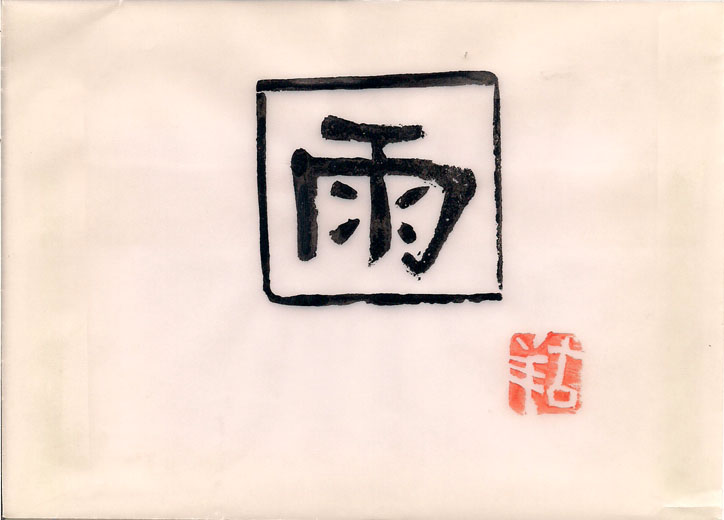
ubrfcvrUntouched By Rain was published in 2005 by Empty Head Press in a limited edition, lettered A through Z, signed by the author and bearing his seal, “old goat.” Each hand-made book has a unique cover, many as reproductions of  uchiwa-e, Japanese fan prints, features silk screened Japanese end papers, and is hand sewn in the Japanese four-hole side stitch binding.  The black & white illustrations accompanying the tanka represent traditional Japanese motifs such as the cherry blossom, crane, bamboo, and pine. Untouched By Rain, and a companion selection of tanka, Thin Wings, were originally made to be sold through the gift shop at the Sonoma County Museum.  Up until the gallery’s recent closing, both tanka selections were also offered through The Quicksilver Mine Company.  Less than a handful of copies of Untouched By Rain are still available.  Inquiries welcome.

presentation envelope

Click to view a pdf facsimile of Untouched By Rain 2005

Tanka, meaning ‘short song,’ is an unrhymed poem with a fixed thirty-one syllable pattern of 5-7-5-7-7.  In Westernized stanza form, it is a five line poem.   Tanka, one of the oldest of Japanese verse forms, dates back to before the 11th Century.  Tanka gained renewed popularity in the late 19th Century among radically modern young poets who brought its diction and subject matter up to date.  Historically, tanka is a precursor to renga, haikai, and haiku.  The poems in Untouched By Rain do not follow precisely the fixed syllabic count nor do they conform to many of the accepted tanka conventions but seek a synthesis and accommodation brought about by translation into a radically different language and culture. 

Limited Edition: Boxes & Chairs

Boxes & Chairs

By Gail King

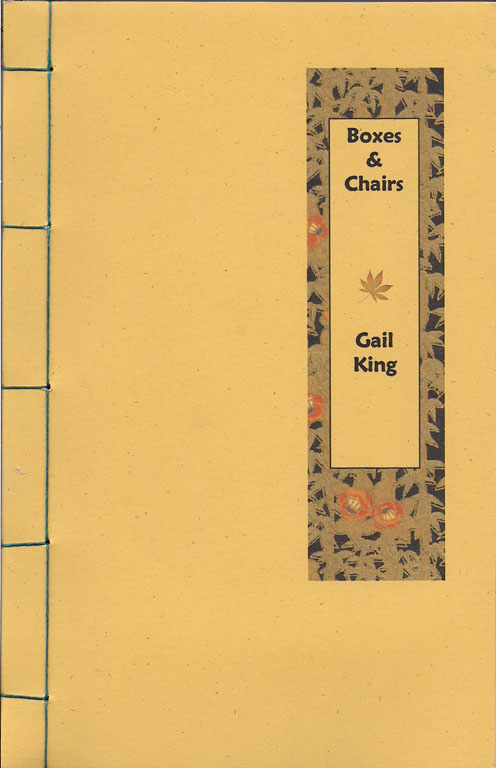
BCFBoxes & Chairs was originally published in 2006 as a handmade limited gift edition of twenty five for family and friends. The covers were printed on heavy weight Reeves print stock with Japanese silkscreen end papers and binding strips. The book was bound in the traditional Japanese four-hole binding style. Illustrations accompanying the poems are reproductions of kuchi-e, woodblock prints that were used to illustrate short stories in Meiji era magazines and journals of late 19th Century Japan.

Subsequently an unlimited ‘people’s’ edition was issued with a plain cover but with the original text and illustrations intact.

People's Edition
People’s Edition

Gail King has been active in writing and publishing in the Russian River area since the mid 70’s. A Northern California native, she writes stories of growing up in the East Bay (Oakland/ San Leandro) as well as poetry focusing on the California landscape. She was the publisher of Doris Green Editions, a small literary press active in the ‘70’s and ‘80’s. Boxes & Chairs, published by What Leaf Press, is her second collection of poems. A more comprehensive selection of her poems is slated for publication by Nualláin House, Publishers, in the Fall of 2013 which will include the entirety of Boxes & Chairs.

Praise for Boxes & Chairs:

“Gail King’s poems celebrate the change and deep pleasures in tracking transformation. With a sinuous and penetrating wit King remembers her life via alarm, humor and love: a night ago the wind/ and rain let us in on a secret/ our forts are temporary/ no rest inside the box.”
— Keith Kumasen Abbott

“Reading Gail King has always been one of my great poetry pleasures. Her inimitable voice narrates the world with humor and tenderness, a world of beauty and occasional sorrow. Her work has healing effects.”
— Andrei Codrescu

“. . .a lovely lovely book. . .with direct beauty of what actually happens. [The poems] are all about SOMETHING, not just states of mind mired in ‘language’.”
— Joanne Kyger

Click to view a pdf facsimile of the limited gift edition of  Boxes & Chairs

Limited Edition: Where The Four Winds Blow (translations)

Where The Four Winds Blow
(including Epitaphs)
by Philippe Soupault

  (translated from the French by Pat Nolan)

soupfcvrjPhilippe Soupault , born in 1897, was one of the most original poets of his time.  He collaborated with Andre Breton on the premiere Surrealist document, Les Champs Magnetiques, and was a co-founder of La Revolution Surrealiste, the seminal surrealist publication.  To this day the poems of Where The Four Winds Blow (1920) and Epitaphs (1919) have that modern sense of the personal, the existential observer, always slightly perplexed.  Much of what is conventional in modern poetry today was first realized in the innovations of these early poems.

Where The Four Winds Blow was published under the Pygmy Forest Press (Albion CA) imprint in 1993 by the late poet Leonard Cirino.

Praise for Where The Four Winds Blow

It’s a great pleasure to see two of one’s favorite poets across time and space conjoined in these terrific translations of Philippe Soupault’s early poems by Pat Nolan who catches and plays the haunting and funny early century notes just right. 
— Anselm Hollo

Pat Nolan’s translations get the edge and eye of Philippe Soupault’s witty, shifty and insouciant early poems, often displaying the right touch for the quick change artistry of the poet at work.
— Keith Abbott

It’s a great pleasure to see Philippe Soupault’s graceful, delicate, and gently witty poems getting more of the attention they deserve.
— Ron Padgett

View a pdf facsimile of FOURWINDS

Limited Edition: Later

LATER
Selected Poems

  by Pat Nolan  

laterfrntjIn 2007 On The Fly Press issued LATER, Selected Poems featuring a representation of poems first published in literary magazines and anthologies including Exquisite Corpse, Golden Handcuffs, Court Green, Hanging Loose, Kickass Review, Otolith, Paper Tiger, Prosodia, Watching The Wheels: A Blackbird, and Thus Spake The Corpse V. 1 & 2, as well as in The Nolan Anthology Of Poetry V.2, The Modern Era (2003), Tangram Poem Card Series (2005), and Untouched By Rain (2006).

LATER was printed in a limited edition hand bound in the Japanese side-stitch style with covers printed on gray-green stock.  A limited number of copies are still available for $10 US plus shipping.  Please see How To Order.

To view a pdf facsimile, click on Later Selected Poems 2007

Limited Edition: Ah Bolinas!

Ah Bolinas!
A Travel Journal

by Pat Nolan


In the late fall of 1984, Pat Nolan was invited by Joanne Kyger to read his poetry as part of a reading series held at the Bolinas Library.  Nolan later memorialized the event in a Japanese style travel diary(nikki) similar to those written by Basho on his various journeys to visit other poets and collaborate on linked verse (haikai no renga). It was originally published in Andrei Codrescu’s Exquisite Corpse in 2000 as To Bolinas And Back.  As published in  limited edition, the prose and poems in Ah Bolinas! are organized in a manner similar to those found in the Japanese form, haibun.  

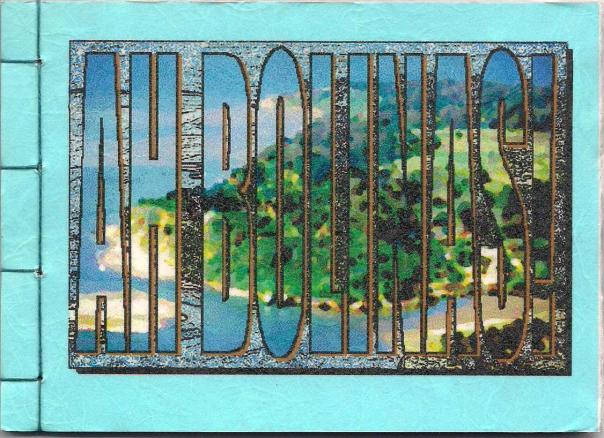
In 2010 Not My Hat Press issued the travel journal now titled Ah Bolinas! in a limited edition of 26 signed copies, lettered A through Z and accompanied by four original linoleum block prints.  The covers are printed on a heavy weight mulberry washi with Japanese silk screen end papers and bound in the Japanese four hole style.  The blocks were carved by the author and printed with the generous assistance of master printer Les Ferriss of Healdsburg, CA.   4×5.63 (10.2×14.1 cm) 

To view a pdf facsimile, please click AH BOLINAS 2010

Limited Edition: Intellectual Pretensions

Intellectual Pretensions
Prose Poems by Pat Nolan

Nearly a century ago Max Jacob wrote “Many prose poems have been written in the last thirty or forty years; I hardly know of any poet who’s understood what it’s all about and who’s known how to sacrifice his ambitions as an author to the prose poem’s formal constitution.  Dimension counts for nothing in the beauty of a work, its situation and style are everything.”  Those words are presciently accurate today.

The prose poems in Pat Nolan’s Intellectual Pretensions draw their inspiration directly from the mysticism of the French poet Max Jacob and his revolutionary volume, Le cornet à dés, first published in 1916.  Here, each prose poem, paragraph or sequence of paragraphs is a portal into a separate and uniquely fantastic universe that runs the gamut from the phantasm of a dream landscape to the playful meandering byways of a shaggy dog tale.     

Intellectual Pretension was published in 2009 in a limited edition on Gainsborough cover stock, the design mimicking that of editions of Max Jacob’s poems published by Gallimard/Nouvelle Revue Française, and individually hand sewn in the Japanese side stitch style binding. 41 pages, 8.5×5.5 inches (21.5×14.1 cm)  Copies of Intellectual Pretension are no longer available.  However, you may view the pdf of INTELLECTUAL PRETENSIONS 2009 here.

Intellectual Pretension was also published in its entirety in The Corpse Annual #2 (2010), and reviewed by Gabriel Ricard in the Unlikely Stories blog.


Limited Edition: Poetry For Sale

Poetry For Sale

Haikai No Renga

By Keith Kumasen Abbott and Pat Nolan

Poetry For Sale is a limited edition haikai no renga (linked verse) published by Mountain Forest River Editions in 2008.  The size of the edition was linked to the number of stanzas in a kasen, a standard renga length employed by Basho and his disciples, and in the memorializing of the 36 immortal poets of Japanese literature; Poetry For Sale is also a kasen.   A variety of covers were printed (of which the accompanying image is only one of a half dozen) on 100% recycled Bogus Art paper and bound in the Yamato style using handmade ribbons of Japanese silkscreened paper.
Dimensions, w7 x h8 inches (18 x21.3 cm).
                                                                   

Keith Kumasen Abbott and Pat Nolan have engaged in the practice of haikai no renga over a period of thirty years.  They are founding members, along with Michael Sowl and Maureen Owen, of The Miner School of Haikai Poets. The Miner School’s haikai have been published in numerous magazine including Hanging Loose, Exquisite Corpse, Jack’s Magazine, Big Bridge, and Simply Haiku as well as limited edition chapbooks and broadsides from Empty Head Press, Bamboo Leaf Studio, and Tangram Press.  Their kasen, All Ears, was included in Saints Of Hysteria, an anthology celebrating collaboration, from Soft Skull Press (2007).  

One of the unique features of Miner School haikai is that it includes a running commentary by the authors on each of their own stanzas as well as a stab at their collaborators’ links.  It functions in a way similar to commentary provided as a special features audio track on a DVD.  In his introductory comment, Pat Nolan explains how the idea to write Poetry For Sale came about and how it would proceed:

I had been reading Earl Miner’s The Monkey’s Straw Raincoat for some clarification on an aspect of haikai and by chance reread his translation of the delightfully quirky haikai, Poetry Is What I Sell, written by Basho and Kikaku.  Miner speculated that the haikai might have even been used as a prospectus to garner new students.  I streamlined Miner’s version of the hokku and sent it off to my long time haikai partner Keith Kumasen Abbott with the idea of replicating the spirit of this haikai; he would be Basho and I would be Kikaku.  After some initial confusion, we followed the sequence that Miner set out in his introduction to this oddly hilarious renga

Haikai no renga is a form of renga (Japanese linked verse) practiced by Basho (1644-1694) and his disciples, one of whom was the above mentioned Kikaku (1661–1707).  It consists of a 17 syllable verse and a 14 syllable verse provided in turn by the poets engaged in the collaboration.  In linking verses, a 31 syllable poem is produced, the latter verse of which (the 17 or the 14 syllable) will go on to join the next in the sequence to form its own unique poem, and so on until the requisite number of stanzas has been achieved.  Renga sequences can number into the hundreds.  Basho favored the economy of 36 stanzas.  Renku is diminutive for haikai no renga also known as haikai.  The more renowned Japanese verse form, haiku, is derived from the practice of amassing numerous hokku to vie for the privilege of opening a moon-viewing- sake-sipping evening of friendly literary collaboration.   Renga itself is derived from the courtly form of poetry exchanged by the aristocracy as exemplified in Murasaki’s  11th Century The Tale Of Genji.  The rules of the composition for renga and haikai no renga are complicated and arcane, but like those of chess or go can be captivating and stimulating.

For more on the intriguing subject of Japanese Linked Verse, see Earl Miner’s Japanese Linked Poetry (Princeton, 1979) and Hiroaki Sato’s One Hundred Frogs (Weatherhill, 1983).  Also, the introductory essay to the kasen Bamboo Greeting, published in Simply Haiku (2008), further details some of the unconventional methods practiced by The Miner School of Haikai Poets. 

A pdf facsimile of Poetry For Sale can be found here.