Tag Archives: independent publishers

Limited Edition: Carved In Stone

carvedcvrf
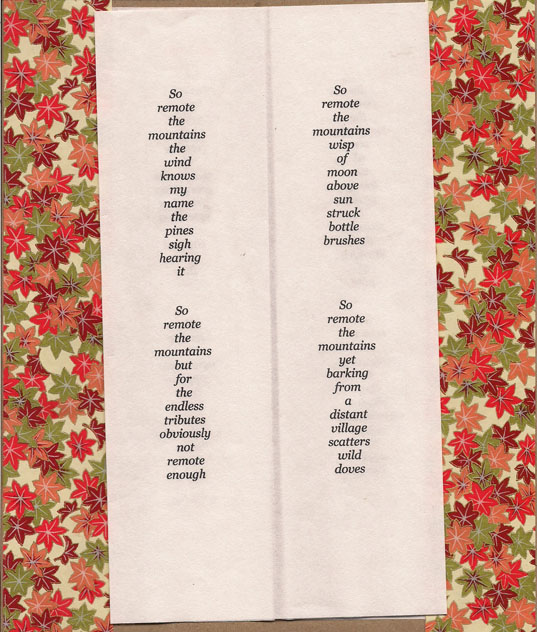
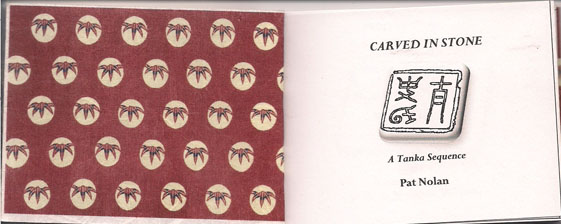
Carved In Stone, a tanka sequence by Pat Nolan, was published by Empty Head Press in the Summer of 2013 in a limited numbered edition signed by the author with his seal.  The covers are printed on heavy weight dragon cloud washi featuring reproductions of one of four Japanese prints from the series Imayo sugata (Stylish Appearances) as are the bamboo leaf endpapers.  Carved In Stone measures 4.25×3 inches (10.7×7.8 cm) and is bound in the Yamato style binding.  The 26 text pages (including 5 illustration) are printed on recycled paper.
 carvedend

Tanka ,meaning ‘short song,’ is an unrhymed poem with a fixed thirty-one syllable pattern of 5-7-5-7-7.  In Westernized stanza form, it is a five line poem.   Tanka, one of the oldest of Japanese verse forms, dates back to before the 11th Century.  Tanka gained renewed popularity in the late 19th Century among radically modern young poets who brought its diction and subject matter up to date.  Historically, tanka is a precursor to renga, haikai, and haiku.
   carvedpem2                                 

The poems in Carved In Stone do not follow precisely the fixed syllabic count nor do they conform to many of the accepted tanka conventions but seek a synthesis and accommodation brought about by translation into a radically different language and culture.

carvedcvrb
A few copies of Carved In Stone are still available from the publisher for $20 each plus shipping.  See How To Order for more information.

Limited Edition: All Ears

All Ears

haikai no renga by Keith Kumasen Abbott, Pat Nolan, Maureen Owen & Michael Sowl

Renku PoetsAll Ears, a haikai no renga or linked verse, was the first of the collaborations between Maureen Owen, Keith Kumasen Abbott, Michael Sowl, and Pat Nolan to be made into a limited edition handmade book and was published by Empty Head Press in 2004.  Subsequently, Random Rocks and Poetry For Sale, both haikai no renga, were issued as limited edition handmade books(see Nualláin House archives for July 2013 and October 2012).  All Ears was also included in the anthology Saints of Hysteria, A Half Century of Collaborative American Poetry (Soft Skull Press, 2007).   

All Ears was composed through the mail over a period of a year and a half beginning in early 1992.  Once the 36 stanzas (kasen) of the haikai-no-renga were completed, each poet was asked to comment on the process in general, and on their own stanzas and those of their collaborators.  The arrangement of stanza follows the standard haikai form of 8 stanzas on the first sheet and 8 stanzas on the back sheet with the remaining 20 stanzas taking up the central text.  Following the haikai no renga and the commentary by the poets is the sequence showing the stanza assignment as well as which poets had the moon and flower stanzas.   

All Ears was bound using repurposed “sticks & strings” wallpaper sheets from a wallpaper sample book as cover stock and backed with Japanese silkscreen endpapers.  Each cover was unique in itself. The pages were folded vertically with a folded leading edge as is common in Japanese books.  Each book was hand sewn using a Japanese side stitch style known “tortoiseshell.”  The dimensions are 4.25×10 inches (10.5×16.5 cm).  Only a limited number of All Ears were produced and it is out of print. 

For more on the intriguing subject of Japanese Linked Verse, see Earl Miner’s Japanese Linked Poetry (Princeton, 1979), Hiroaki Sato’s One Hundred Frogs (Weatherhill, 1983), and Haruo Shirane’s Traces Of Dreams (Stanford, 1998).

To view a PDF facsimile of All Ears, click on ALL EARS 2004

Nualláin House So Far

HELLOLIFEjHello Life by Gail King
Poetry; The poems of Hello Life achieve their freshness in the particularity of experience. The poet surrenders herself to the moment and tenders that subtle cognition as a delighted welcome to life. The ease of her expression in dealing with the everyday communicates an uncommon wisdom. The poems present, through playful understatement and sly humor, the immediacy of spontaneous impressions. Maureen Owen, former artistic director for The Poetry Project in NYC and author of Edges of Water and Erosion’s Pull, says In Gail King’s poems the events of the day become transformative, the images of the temporary become immediate, and the mystery of being alive in the Now unfolds. “…time like a lake breeze” says the poet, and the wind rises.” Gail King’s poems have also won the praise of Andrei Codrescu, poet, novelist, essayist and NPR commentator, author of So Recent Rent A World, who said “Reading Gail King has always been one of my great poetry pleasures. Her inimitable voice narrates the world with humor and tenderness, a world of beauty and occasional sorrow. Her work has healing effects.”
December 2013  ~  $16.00  ~  64 pages ~ Paper  ~  ISBN 978-0-9840310-3-0


The Last ResortThe Last Resort, A Lee Malone Adventure by Pat Nolan
Meta Pulp– Pat Nolan has written a fast paced, tongue-in-cheek, pun filled comedy of errors, misunderstandings, and faux intuition in the mode of a 1930’s pulp thriller to talk about the pulp fiction of that era.  In doing so, The Last Resort presents an unlikely set of circumstances in which a worldly-wise female reporter must untangle herself from her past in order to deal with the puzzling events of her present.  Rather than the typical splinter-jawed, broken nosed, tobacco breathed tough guy hero, Nolan upends the stereotype by introducing a gorgeous internationally famous former fashion model whose super power is her beauty.  THE LAST RESORT, A Lee Malone Adventure, is a quirky, entertaining recreation of the lurid screed that once peopled pulp pages on newsstands everywhere.
August 2012 ~ $19.99 ~ 212 pages ~ Paper~ ISBN 978-0-9840310-2-3

“Has-been supermodel Lee Malone retains her drop-dead gorgeous looks—and haute couture wardrobe—and uses them every chance she gets to solve a murder mystery and live to write about it in The Last Resort: A Lee Malone Adventure. Author Pat Nolan sets this labyrinthine adventure in his home turf along the Russian River communities, renamed the Corkscrew River in the book. Having survived a botched kidnap attempt and a rescue by a secret female militia, Malone seeks the “quiet life” among the redwoods. She writes puff pieces for the Corkscrew County Grapevine, but stumbles into a deeper, more sinister story. Nolan weaves his heroine’s backstory throughout, touching on issues of homelessness, sex slavery, pornography and ever-changing relationships in river communities, while retaining a sense of humor and comic relief.”
— North Bay Bohemian, Fall Literary Issue, 2012


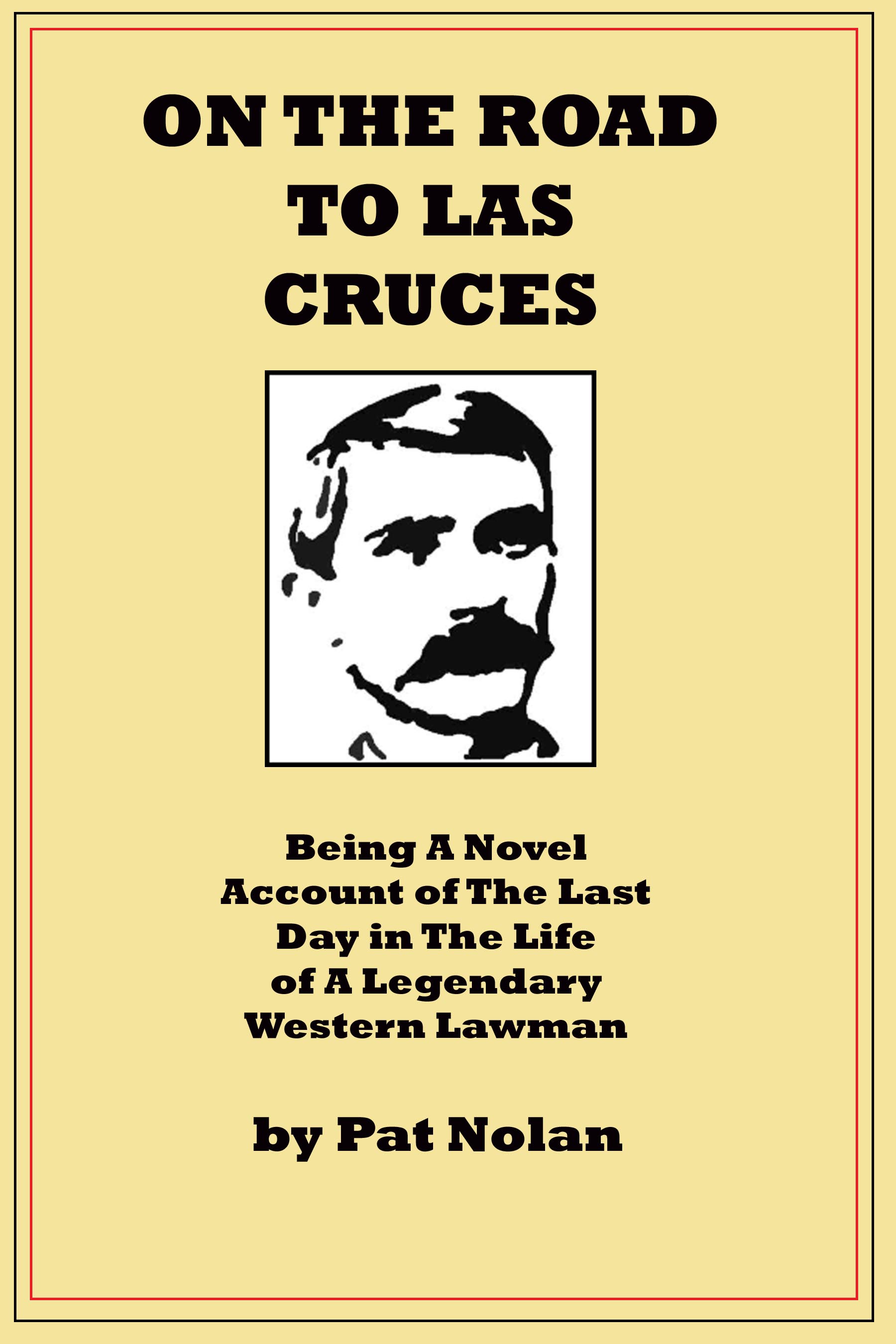
ontheroadfront300On The Road To Las Cruces, Being A Novel Account of The Last Day In The Life of A Legendary Western Lawman by Pat Nolan
Historical Fiction; On The Road To Las Cruces, a work of fiction tethered loosely to historical fact, is the story of the relationship between two men, one garrulous, the other taciturn, the Mutt and Jeff of the old Southwest.  What is related on the road to Las Cruces is as much a retelling of some history as it is how such a retelling might come about, and is represented in the manner of a tall tale, the deadpan details of a crime story, melodrama, and a conspiracy to murder. The road to Las Cruces is full of twists and turns.  The sound of a door slamming like a gunshot brings us into the world of the old Southwest and the gun violence of that historical era.  More than just the tale of a legendary lawman who remains nameless to the end, it is a lesson in storytelling and an allegory for how lives were lived and how death was dealt.  As much a dusty tale of buffalo hunts and shoot-outs as a politically driven “whodunit,” On The Road To Las Cruces is the story of youthful bravado and an old man’s regret.
November, 2011 ~ $16.99 ~ 154 pages ~ paper ~ ISBN 978-0-9840310-1-6

   “. . . a real old-fashioned Western. Page-turner. There are all sorts of funny sly mixes in the story, good Nolan humor, great repartee. . . .” – Andrei Codrescu, NPR commentator and author of Whatever Gets You Through The Night.                              

“Pat Nolan is not only one of our finest living poets. . . but now surprises with a prose paean to the West. Whatever Pat writes deserves to be read and remembered.” – Barry Gifford, author of Wild At Heart and Sailor And Lula


What is being said about Gail King

Gail King lives in a shed and has been getting away with murder for years.  This can be explained in part by quoting Hugh Kenner who said “American genius (in literature) cannot be distinguished by a casual glance from charlatanry. Purity of intention lies at the heart of American achievement.”  

Of her recent book of poems, Hello Life, Keith Kumasen Abbott, professor emeritus and author of numerous books of poetry, prose, and non-fiction, including Downstream from Trout Fishing In America, a Memoir, says In Hello Life Gail King often uses sleight of hand as she guides readers into a scene, a mood, a spiral, then disappears while events continue for us alone. Her art is beguiling, comic, candid and a pleasure.” 

Maureen Owen, former artistic director for The Poetry Project in NYC and author of many books of poems, including Edges of Water and Erosion’s Pull, says In Gail King’s poems the events of the day become transformative, the images of the temporary become immediate, and the mystery of being alive in the Now unfolds. “…time like a lake breeze” says the poet, and the wind rises.”

Gail King’s previous book of poems, Boxes & Chair (What Leaf Press, 2006) won the praise of Andrei Codrescu, poet, novelist, essayist and NPR commentator, author of So Recent Rent A World, who said “Reading Gail King has always been one of my great poetry pleasures. Her inimitable voice narrates the world with humor and tenderness, a world of beauty and occasional sorrow. Her work has healing effects.”

Joanne Kyger, author of more than twenty books of poetry and prose, including About Now: Collected Poems, and recipient of the 2008 PEN Oakland Josephine Miles National Literary Award for Poetry said of Boxes & Chairs “. . .a lovely lovely book. . .with direct beauty of what actually happens. [The poems] are all about SOMETHING, not just states of mind mired in ‘language’.”

Gail King, a Bay Area native, has lived in the Northern California town of Monte Rio for over 40 years. She has written poetry all her adult life and was the publisher of Doris Green Editions, a small literary press active in the ‘70’s and ‘80’s.  Boxes & Chairs, her third selection of poems, was published by What Leaf Press in 2006. Many of the poems featured in that selection are included in Hello Life.


HELLOLIFEj

December 2013  ~  $16.00  ~  64 pages ~ Paper  ~  ISBN 978-0-9840310-3-0

 now available from
Nualláin House, Publishers
Box 798 Monte Rio,California, 95462
(free shipping through December 31st, 2013)


The Nolan Anthology of Poetry, Volume II: The Modern Era

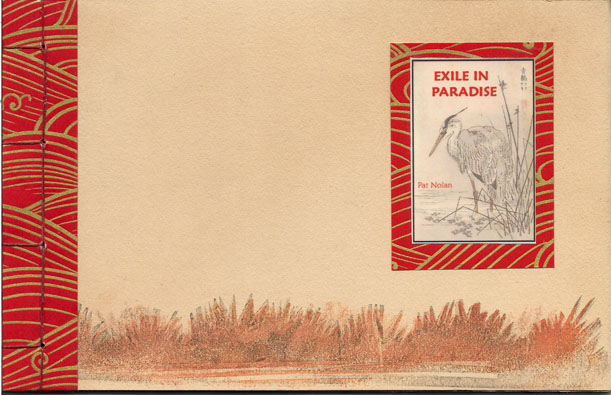
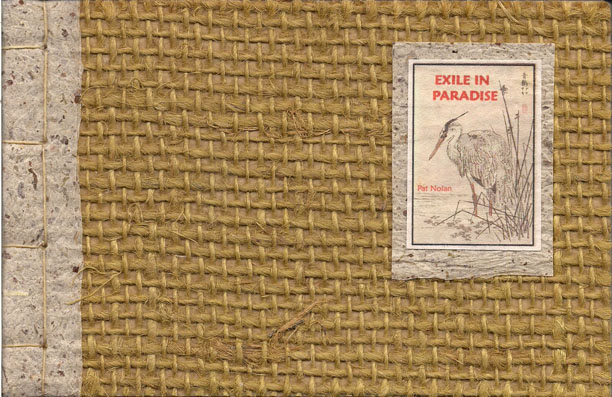
anthcvr1The Nolan Anthology of Poetry, Volume II was published by Fell Swoop in 2003.  The first Nolan Anthology of Poetry was published in 1993 by the same New Orleans publisher.  Volume II (Fell Swoop #64) The Modern Era was printed in an unspecified print run using basically the same 8.5×11 stapled binding format as the first volume though designating them as “volumes” may be a bit of overstatement as each is only twenty pages in length printed on a single side of the page.  The cover design by the author was meant to replicate the pocket poetry books of the French publisher, Gallimard under the NRF (Nouvelle Revue Française) imprint.  Volume II, as did Volume I, represents a sampling from a variety of the author’s poetry manuscript unpublished at the time.  Since then the poems in the tanka sequence Light Years have been included in a handmade limited edition chap book entitled Carved In Stone (Empty Head Press, 2013).  The Chinese style poems were published as a selection entitled Exile In Paradise (Bamboo Leaf Studio, 2009), also as a handmade limited edition.  The prose poems were included in a handmade chap book entitled Intellectual Pretensions (edition de Jacob, 2009).

Click here for The Nolan Anthology of Poetry, Volume II: The Modern Era 2003

A word about Fell Swoop magazine whose stated mission, as per Editor Reverend XJ Dailey, is to destroy contemporary American poetry: this year marks the 30th Anniversary of their fitful yet courageously tenacious low tech existence.  They (3rd person plural used advisedly) will publish their 130th issue this November.  Past featured authors and contributors to Fell Swoop magazine include Andrei Codrescu, Aram Sayroyan, Bernadette Meyer, The Clark Coolidge, Sir Thomas Weigel, Richard Martin, Camille Martin, Lady Alice Notley, and Keith Kumasen Abbott to name just a few.  As an unpretentious and somewhat anachronistic photo copy (xerographic) publication, Fell Swoop harkens back to the more innocent days of the mimeograph revolution when such prehistoric publications as Fuck You, C, Blue Suede Shoes, The End, Life of Crime, and The World roamed the humid fecund swamps of Am Po’s armpit.  Though based in New Orleans, they represent one of the last unapologetic bastions of the New York School of Poets scattered to the four (or five) corners of the poetry universe after the passing of the Grand Himself, Ted Berrigan.  Fell Swoop keeps the flame alive to light another Chesterfield.   Their post-Katrina address is Po Box 740158 New Orleans, LA 70174.  Send them a bunch of cash, in one fell swoop.


Limited Edition: Jacks Or Better

Jacks Or Better

by Pat Nolan

Jacks Or Better is a travel journal (kikobun) in the tradition of Basho’s Narrow Roads To Far Off Places.  The narrow road followed in this journal is the iron road, from San Francisco to rural Florida with stops in New Orleans and Baton Rouge.  It is a poet’s journey expressed as haibun in which descriptive or expressionistic prose is capped by a haiku-like poem that continues the thread, elucidates it, or offers a disparate juxtaposition.  Published by Egret Moon Press in 2011 in a limited edition of 36 copies. 38 pages hand-bound with Japanese stitching between grey repurposed paper covers, 7×7.25 inches (18x19cm).


jobfcvrfrom Jacks Or Better 

Although this is my first trip to New Orleans, I’ve taken trains across country before and have always found that if you’re on a schedule they are the last place to be.  But if you’re not in a hurry, they enforce a leisurely pace that is fast becoming antique. My final destination is Florida where I will visit with my parents.  The first leg will take most of three days. This trip is ostensibly about the anatomy of a friendship and the relationship between generations.  I will visit with Andrei Codrescu in New Orleans and lecture to his MA classes at Louisiana State University. 

Baton Rouge
“only place in America named
         after a dog’s dick”


 To view a pdf facsimile click JACKS OR BETTER 2011

Limited Edition: Carbon Data

Carbon Data

By Pat Nolan


carbon dataCarbon Data is a limited edition poetry selection published by Last Cookie Press in 2008, bound with 60# granite grey cover stock in the Japanese four-hole style.  35 pages, 8.5×5.5 

The poems in Carbon Data first appeared in Fell Swoop, Tight, Exquisite Corpse, Smelt Money, Kickass Review, Watching The Wheels: A Blackbird, Court Green, and Otolith as well as in volumes of selected poetry including Fly By Night (1992), The Nolan Anthology Of Poetry, Vol. II (2003), and Later (2007).  

Pat Nolan’s poetry and prose have been published in numerous magazines including Rolling Stone, The Paris Review, The World, Big Bridge, Poetry Flash, and Exquisite Corpse as well as literary magazines in Europe and Asia.  He is the author of fifteen books of poetry, including LATER from On The Fly Press (2007).  

This limited edition is still available for $10 plus shipping.  Get free shipping when you purchase a copy of either On The Road to Las Cruces or The Last Resort along with Carbon Data.  Click here to preview a pdf facsimile of  CARBON DATA 2008

Limited Edition: Random Rocks

Random Rocks

Haikai No Renga

By The Miner School of Haikai Poets

randrksfcRandom Rocks is a limited edition haikai no renga (linked verse) published by Bamboo Leaf Studio in 2007.  The size of the edition was linked to the number of stanzas in a kasen, a standard renga length employed by Basho and his disciples, and in the memorializing of the 36 immortal poets of Japanese literature.  Random Rocks measures 5.5x 7 (14x17cm), is hand sewn in the Japanese side stitch style, bound in heavy green chiri paper, momogami binding strips and features Japanese silk screen end papers.  The edition was divided evenly among the four haikai poets to distribute as they saw fit.                                                                                        

The Miner School of Haikai Poets have engaged in the practice of haikai no renga over a period of thirty years, written primarily through the mail and more recently, email.  They are Pat Nolan, Keith Kumasen Abbott, Michael Sowl and Maureen Owen. The Miner School’s haikai have been published in numerous magazine including Hanging Loose, Exquisite Corpse, Jack’s Magazine, Big Bridge, and Simply Haiku as well as in limited edition chapbooks and broadsides from Empty Head Press, Bamboo Leaf Studio, and Tangram Press.  Their kasen, All Ears, was included in Saints Of Hysteria, an anthology celebrating collaboration, from Soft Skull Press (2007).   

One of the unique features of Miner School haikai is that it includes a running commentary by the authors on each of their own stanzas as well as a stab at their collaborators’ links.  It functions in a way similar to commentary provided as a special features audio track on a DVD.  The introductory essay to another kasen, Bamboo Greeting, published in Simply Haiku (2008), further details some of the unconventional methods practiced by The Miner School of Haikai Poets.  

Haikai no renga is a form of renga (Japanese linked verse) practiced by Basho (1644-1694) and his disciples.  It consists of a 17 syllable verse and a 14 syllable verse provided in turn by the poets engaged in the collaboration.  In linking verses, a 31 syllable poem is produced, the latter verse of which (the 17 or the 14 syllable) will go on to join the next in the sequence to form its own unique poem, and so on until the requisite number of stanzas has been achieved.  Renga sequences can number into the hundreds.  Basho favored the economy of 36 stanzas.  Renku is diminutive for haikai no renga also known as haikai.  The more renowned Japanese verse form, haiku, is derived from the practice of amassing numerous hokku to vie for the privilege of opening a moon-viewing-sake-sipping evening of friendly literary collaborations.   Renga itself is derived from the courtly form of poetry exchanged by the aristocracy as exemplified in Lady Murasaki’s 11th Century The Tale Of Genji.  The rules of the composition for renga and haikai no renga are complicated and arcane, but like those of chess or go can be captivating and stimulating.  

For more on the intriguing subject of Japanese Linked Verse, see Earl Miner’s Japanese Linked Poetry (Princeton, 1979), Hiroaki Sato’s One Hundred Frogs (Weatherhill, 1983), and Haruo Shirane’s Traces Of Dreams (Stanford, 1998). 

A pdf facsimile of RandomRocks 2007can be found here.


Limited Edition: Boxes & Chairs

Boxes & Chairs

By Gail King

BCFBoxes & Chairs was originally published in 2006 as a handmade limited gift edition of twenty five for family and friends. The covers were printed on heavy weight Reeves print stock with Japanese silkscreen end papers and binding strips. The book was bound in the traditional Japanese four-hole binding style. Illustrations accompanying the poems are reproductions of kuchi-e, woodblock prints that were used to illustrate short stories in Meiji era magazines and journals of late 19th Century Japan.

Subsequently an unlimited ‘people’s’ edition was issued with a plain cover but with the original text and illustrations intact.

People's Edition
People’s Edition

Gail King has been active in writing and publishing in the Russian River area since the mid 70’s. A Northern California native, she writes stories of growing up in the East Bay (Oakland/ San Leandro) as well as poetry focusing on the California landscape. She was the publisher of Doris Green Editions, a small literary press active in the ‘70’s and ‘80’s. Boxes & Chairs, published by What Leaf Press, is her second collection of poems. A more comprehensive selection of her poems is slated for publication by Nualláin House, Publishers, in the Fall of 2013 which will include the entirety of Boxes & Chairs.

Praise for Boxes & Chairs:

“Gail King’s poems celebrate the change and deep pleasures in tracking transformation. With a sinuous and penetrating wit King remembers her life via alarm, humor and love: a night ago the wind/ and rain let us in on a secret/ our forts are temporary/ no rest inside the box.”
— Keith Kumasen Abbott

“Reading Gail King has always been one of my great poetry pleasures. Her inimitable voice narrates the world with humor and tenderness, a world of beauty and occasional sorrow. Her work has healing effects.”
— Andrei Codrescu

“. . .a lovely lovely book. . .with direct beauty of what actually happens. [The poems] are all about SOMETHING, not just states of mind mired in ‘language’.”
— Joanne Kyger

Click to view a pdf facsimile of the limited gift edition of  Boxes & Chairs

DICK LIT: Q&A with Pat Nolan

warning uspoet
Q: You’re known primarily for your poetry, why are you now writing fiction?

A:  Actually when I first thought to write, I wanted to write fiction.  Novels, short stories.

Q:  What turned you to poetry?

A:  A wider experience of reading, other than the best sellers on the paperback racks at the corner drug store and the science fiction shelf at the local library.  I came to reading late but once I did I was a voracious reader. By the time I graduated from high school I knew there was more to reading than just pop fiction.

Q:  Wasn’t your reading guided by what you were taught in the classroom?

A:  I was an indifferent student.  Most of my reading centered around what I discovered for myself.  While in the Navy I was lucky to have shipmates who were quite literate.  Everyone in my rating read. A couple of guys even had some college under their belts.  Paperbacks were a regular item of exchange, mostly westerns, crime fiction, smut.  Lady Chatterley’s Lover made the rounds.  For obvious reasons. And Miller’s Tropics.  I was into Kerouac then, and always on the lookout for more by him.  Someone suggested that I check out a bookstore in San Diego where my ship was stationed.  I’d never been to a bookstore before, a real bookstore that wasn’t a news stand or the book section in a department store.

Q:  I find that shocking.  How old were you then?

A:  Oh, eighteen, nineteen.  And I think I was a little intimidated by the place.  It was a small store front on a side street crammed to the rafters with books.  I’d never seen so many books outside of a library.  Anyway, I asked after any new Kerouac titles but they only had ones I’d already read.  The clerk showed me a book by someone he said was a friend of Kerouac’s.  It was A Coney Island Of The Mind by Lawrence Ferlinghetti.  Poetry.  I think I bought it just so I could get out of there and not feel like a complete idiot.

Q:  Did you start writing poetry then?

A:  Not really.  I mean, I’d already tried my hand at writing poems so I had a notion of what a poem was, a conventional Romantic notion, and it had to do with expressing emotions toward a loved one, usually an indifferent unresponsive young woman.  They were all very ardent.  No one ever saw them.  I wasn’t very serious about it, anyway.

Q:  You must have become serious eventually.

A:  Yes, eventually.  One thing leads to another.  I started including poetry in my reading .  I can’t say I got all that was going on.  It wasn’t like reading popular fiction.  But it was interesting, challenging.  I came across Don Allen’s New American Poetry.  That was a revelation.  And I started noting references to names of other poets and writers.  Baudelaire, Rimbaud, Pound, Williams.  So I began looking into those guys, and they led me to other writers and poets.  At one point all my reading was taken up with tracking down a wider variety of writers and finding out more about them, their writing.

Q:  Were you also writing poetry at this time?

A:  That kind of went hand in hand with my reading.  In order to understand what the poets were doing I had to try to replicate what they were doing in a kind of reverse engineering.  It’s not as easy as it sounds.  I was concentrating on contemporary American poets for the most part, and it was pretty much anything goes, or that’s what it seemed like.  Looking back, I can see that I was really just pissing in the wind.

Q:  Yet you were published in some pretty impressive magazines.  Rolling Stone, The Paris Review, Exquisite Corpse.  And in a number of anthologies.  Don’t you think you were doing something right?

A:  Well, thanks to the kindness of strangers and the indulgence of friends. Not without some trepidation on my part, I have to say.  Success tends to complicate things.

Q:  So after many years you’ve turned back to fiction.  Why?

A:  I never turned away from fiction.  It’s just that the learning curve with poetry is steeper and requires greater diligence.  Around the same time that I had my first book published and was invited to read at the Poetry Project in New York City, I had also written two novels, one of which remained in draft form, and the other as a final manuscript. That was the first version of the western.  Even though I was experiencing relative success as a poet, writing novels was never out as an option.  And novels are a different kind of challenge.  Physically, logistically, especially back when everything was written on a typewriter.  Large chunks of specific time are required.  I feel like I could probably write poetry on the run, but the writing of a novel, for me at least, requires consistency, more sit down time.  And back then, a lot of white out, scissors, glue.  The construction of a final draft was an engineering feat.   Sorting through the renumbered pages with whole blocks of writing crossed out and painstakingly stitching it all back together.  Just the thought of it makes me shudder.

Q: What became of those early novels?

A:  The western made the rounds of agents and publishers but no one was interested.  Thankfully.  And the first draft novel was recycled into a general idea for a story.  I kept the title and the locale.

Q:  One of your recently published novels, On The Road To Las Cruces, is a western.  Is this the same novel?

A:  It’s the same subject, but the narrative has changed considerably.  Even though I had put it aside, the story and the need to tell it stayed with me, and I would go back and rewrite parts or scribble in the margins my additions or redirections.  That went on for several years and finally computers caught up with me and I spent many hours transcribing my typewritten poetry manuscripts as computer documents.  I also transcribed my western which allowed me to incorporate some of the revisions I had arrived at.  And in the process of transcribing, I also rewrote.

Q:  Technology benefitted your processes, in other words.

A:  Technology always changes the way you do business.  Writing a novel is no different.  And as an added advantage, word processors allow, among other things, cut and paste techniques at one time available only to film editors.

Q:  Are you utilizing those tools the way they are in the cinema?

A:  In a way, yes, because cinema is a popular story telling art that uses narrative in interesting, innovative ways.  In doing so, certain idioms are coined, clichés generated.  Telling the story on the page can utilize these idioms, techniques, in similar ways since the reading audience and movie goers overlap and recognize the tropes.  I was particularly conscious of using cinematic techniques in the western, mainly because of the complexity of trying to tell the story on three different levels.  There’s the narrative that takes place in real time, the one that takes place in the recent past, and the narrative that’s as a result of introspection and  dialogue with a ghost.

Q:  Did you also use cinematic techniques in the novel you published last year, The Last Resort?

A:  The narrative in The Last Resort has a fairly straight forward first person camera eye chronology with an extended back story flash back that serves as the booster rocket into the wrap up.  There’s also the  cinematic technique of the cliffhanger, the Saturday matinee movie serial.  The chapters, which for the most part are all roughly the same length, end abruptly or as jump cuts.

Q:  You’ve subtitled the novel A Lee Malone Adventure

A:  Lee Malone is based on a character I created for a serial I wrote for a local weekly newspaper years ago about a supermodel sleuth.  I had started some preliminary chapters for another serial when the editorship changed hands and the newspaper was no longer interested in the material. These odds and ends of fiction were among the last to be transcribed as computer documents, and I didn’t pay that much attention to them until some years after that when I read a couple chapters to a few writers I know.  Their reaction told me that I might be on to something.  So I pursued it.

Q:  Your first person narrator is a woman.  Why a woman, and who is she?

A:  Lee Malone is a stereotypical beautiful woman, former international model circa 1985.  What makes her interesting is how she tries to circumvent that cliché and become an authentic person .  In the very limited realm of a not overly realistic genre storyline, of course.  The  protagonist for these kinds of escapades is usually a tough guy with a broken nose, a five o’clock shadow, and breath that can pickle squid.  I was after something different.

Q:  The Last Resort was published in 2012.  Why is the setting in 1985?  Why not a more contemporaneous time?

A:  I had started the early chapters in 1985.  And rather than go back and retool the time frame to something more current, I decided to stick with it and avoid as many anachronisms as possible.  No cell phones or internet back then so that allowed a slower unfolding of the plot and a more leisurely development of the back story on Lee Malone.

Q:  You portray Lee Malone as rather willful.

A:  She has a cocksureness instilled by her life of privilege as a beauty.  And she knows how to use her looks to get what she wants.  But there’s a down side, and that is that all men lust after her and most women hate her.  Her aloofness is also a tragic flaw.  Men are cowed by her imperiousness and women suspect her of treachery.  Consequently she is alone.

Q:  You’ve published two genre novels, one a western and the other a pot boiler.  Are you seeking a conventional audience as opposed to one that was primarily interested in your poetry?

A:  The interest in my poetry in a very qualified sense has always been limited.  I don’t expect that my novels will be read by many more people, conventional or otherwise.  Given that the novels are written by a poet, conventionality was never a consideration.  Other than to label them genre works. Also this imagined audience will undoubtedly encompass many who have read my poems. Anyway, the idea of an audience for my work is always problematic.  I don’t think that my subject matter and how I approach it has universal appeal.  What I write about and how I write might find more support among men than woman.   The western is about gun violence, and the pot boiler, as you characterize it, is about titillation.  These are two things that fascinate men, sex and death.

Q:  Are there more macho centric gender specific novels in your future?

A:  I’m currently working on two crime fiction novels and a series of short stories in the same genre.  They’re detective stories, dick lit, if you will. Dick signifying slang for detective, of course, not the male sexual organ. One is titled simply, A Detective Story, and the other is in between titles right now.

Q:  Why crime fiction, dick lit, rather than something more universal that appeals to everyone?

A:  Crime fiction actually has a universal appeal, at least since Poe, who is said to have pioneered the detective story.  It is essentially comedy, sometimes quite dark, and situational, often improbable.  I feel comfortable with the conventions of genre fiction.  One novel, a period piece set in the 40’s before the war, is an attempt to represent the kind of writing that was being published in the pulp magazines with a little twist of  French surrealism.  The other might be characterized, in an 8 second Mamet pitch, as young Philip Marlowe in the  21st century.

Q:  Let me see if I have that right, you’re writing genre novels in order to write about genre novels.  Would you call that meta-fiction?

A:  I might, but I don’t exactly know what that is.  My characters are fictional, there’s no pretense that they are anyone beyond the page, even if they represent figures in regional history or in the history of fiction.  Every time I sit down to write a poem I am writing the history of poetry. Not in any grand ultimate critique, but in the relationship between myself and poetry.   In the same way, when I sit down to write a novel I am writing the history of fiction.  I have a hyper awareness of what has been written and I naturally factor that into the process

Q:  You’re mimicking a style appropriate to the story you’re telling.  Is that how you approach writing all your novels?

A:  I don’t know.  I’ve only written two so far. But yes, there is an awareness of the genre that determines how, stylistically, it is written.  Writing novel scale fiction requires a degree of engineering, of being more than just a voice but a writer director producer set designer camera lights action.  I assume that anytime a story is told some kind of mimicry is going on.

Q:  For example.

A:  Um, for example, ok.  Well, after the first version of my western was rejected, I was still enjoying my readings in the history of the old Southwest.  This is a subject that had also fascinated me as a young reader.  The more I read, the more of a historical sense I got of the people, the actors upon whom western legends are based.  I read authors from that period, Owen Wister for instance, author of The Virginian, contemporary accounts by Charlie Siringo, and modern regional authors like J. Frank Dobie to get a sense of how the stories of that time were told.  In rewriting the western, I had those voices to accompany me in the telling of my story. Or stories, as there are four stories, told by different storytellers or story telling devices.  What I was after was an underlying tone, a lingering in the language from that time.  In doing so, I didn’t write a conventional western.  It is more matter of fact, laconic, about a subject that has been mined repeatedly.  I gave it a different spin.

Q:  You refer to your reading quite a bit.  How much of a role does reading play in your writing?

A:  Reading is the other side of the coin.  I spend as much time reading as I do writing, maybe more.  I don’t read much fiction though.  I read primarily to satisfy my curiosity about particular subjects.  Neuroscience or cosmology, the micro and the macro of it all.  Sociology, anthropology, history.  These are areas of scholarship that continue to interest me.  To speculate on any of these subjects is what engages the imagination for me.  Coming at it from another way, writing genre novels is a reaching back to the reading that I enjoyed so much when I was younger and inspired me to think I could be a writer, a time of innocence that existed before I stepped into the world of serious literature.

Q:  Now that you are heavily committed to novel pursuits, have you put aside writing poetry for the time being?  Or for good?

A:  Yes, for the good of poetry, I should actually stop, but no, that obsession continues unabated.  And it’s not like I put on a different hat when I sit down to do one or the other.   To paraphrase Philip Whalen, it is something I do all day, every day.  I give the novels the same attention and concentration I give to my poetry.  And the fact that I am primarily a poet simply means that I bring a peculiar sense of language to the table.  These novels might easily be considered very long prose poems, poems on an epic scale.

Based on an interview conducted by Suzanne Lang for A Novel Idea aired on KRCB FM (Rohnert Park, CA) February 13th, 2013; edited, condensed, with material added for continuity and coherence.