Q: You’re known primarily for your poetry, why are you now writing fiction?
A: Actually when I first thought to write, I wanted to write fiction. Novels, short stories.
Q: What turned you to poetry?
A: A wider experience of reading, other than the best sellers on the paperback racks at the corner drug store and the science fiction shelf at the local library. I came to reading late but once I did I was a voracious reader. By the time I graduated from high school I knew there was more to reading than just pop fiction.
Q: Wasn’t your reading guided by what you were taught in the classroom?
A: I was an indifferent student. Most of my reading centered around what I discovered for myself. While in the Navy I was lucky to have shipmates who were quite literate. Everyone in my rating read. A couple of guys even had some college under their belts. Paperbacks were a regular item of exchange, mostly westerns, crime fiction, smut. Lady Chatterley’s Lover made the rounds. For obvious reasons. And Miller’s Tropics. I was into Kerouac then, and always on the lookout for more by him. Someone suggested that I check out a bookstore in San Diego where my ship was stationed. I’d never been to a bookstore before, a real bookstore that wasn’t a news stand or the book section in a department store.
Q: I find that shocking. How old were you then?
A: Oh, eighteen, nineteen. And I think I was a little intimidated by the place. It was a small store front on a side street crammed to the rafters with books. I’d never seen so many books outside of a library. Anyway, I asked after any new Kerouac titles but they only had ones I’d already read. The clerk showed me a book by someone he said was a friend of Kerouac’s. It was A Coney Island Of The Mind by Lawrence Ferlinghetti. Poetry. I think I bought it just so I could get out of there and not feel like a complete idiot.
Q: Did you start writing poetry then?
A: Not really. I mean, I’d already tried my hand at writing poems so I had a notion of what a poem was, a conventional Romantic notion, and it had to do with expressing emotions toward a loved one, usually an indifferent unresponsive young woman. They were all very ardent. No one ever saw them. I wasn’t very serious about it, anyway.
Q: You must have become serious eventually.
A: Yes, eventually. One thing leads to another. I started including poetry in my reading . I can’t say I got all that was going on. It wasn’t like reading popular fiction. But it was interesting, challenging. I came across Don Allen’s New American Poetry. That was a revelation. And I started noting references to names of other poets and writers. Baudelaire, Rimbaud, Pound, Williams. So I began looking into those guys, and they led me to other writers and poets. At one point all my reading was taken up with tracking down a wider variety of writers and finding out more about them, their writing.
Q: Were you also writing poetry at this time?
A: That kind of went hand in hand with my reading. In order to understand what the poets were doing I had to try to replicate what they were doing in a kind of reverse engineering. It’s not as easy as it sounds. I was concentrating on contemporary American poets for the most part, and it was pretty much anything goes, or that’s what it seemed like. Looking back, I can see that I was really just pissing in the wind.
Q: Yet you were published in some pretty impressive magazines. Rolling Stone, The Paris Review, Exquisite Corpse. And in a number of anthologies. Don’t you think you were doing something right?
A: Well, thanks to the kindness of strangers and the indulgence of friends. Not without some trepidation on my part, I have to say. Success tends to complicate things.
Q: So after many years you’ve turned back to fiction. Why?
A: I never turned away from fiction. It’s just that the learning curve with poetry is steeper and requires greater diligence. Around the same time that I had my first book published and was invited to read at the Poetry Project in New York City, I had also written two novels, one of which remained in draft form, and the other as a final manuscript. That was the first version of the western. Even though I was experiencing relative success as a poet, writing novels was never out as an option. And novels are a different kind of challenge. Physically, logistically, especially back when everything was written on a typewriter. Large chunks of specific time are required. I feel like I could probably write poetry on the run, but the writing of a novel, for me at least, requires consistency, more sit down time. And back then, a lot of white out, scissors, glue. The construction of a final draft was an engineering feat. Sorting through the renumbered pages with whole blocks of writing crossed out and painstakingly stitching it all back together. Just the thought of it makes me shudder.
Q: What became of those early novels?
A: The western made the rounds of agents and publishers but no one was interested. Thankfully. And the first draft novel was recycled into a general idea for a story. I kept the title and the locale.
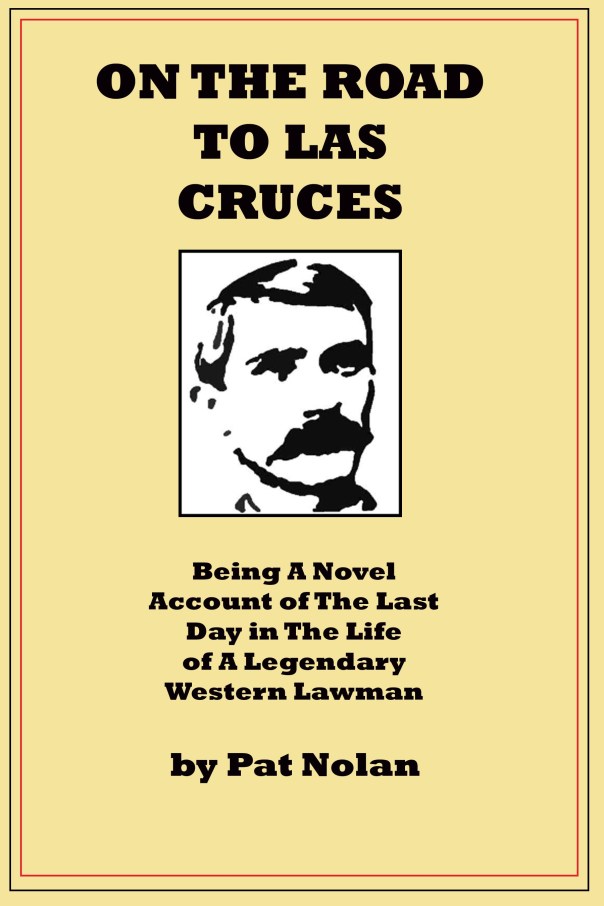
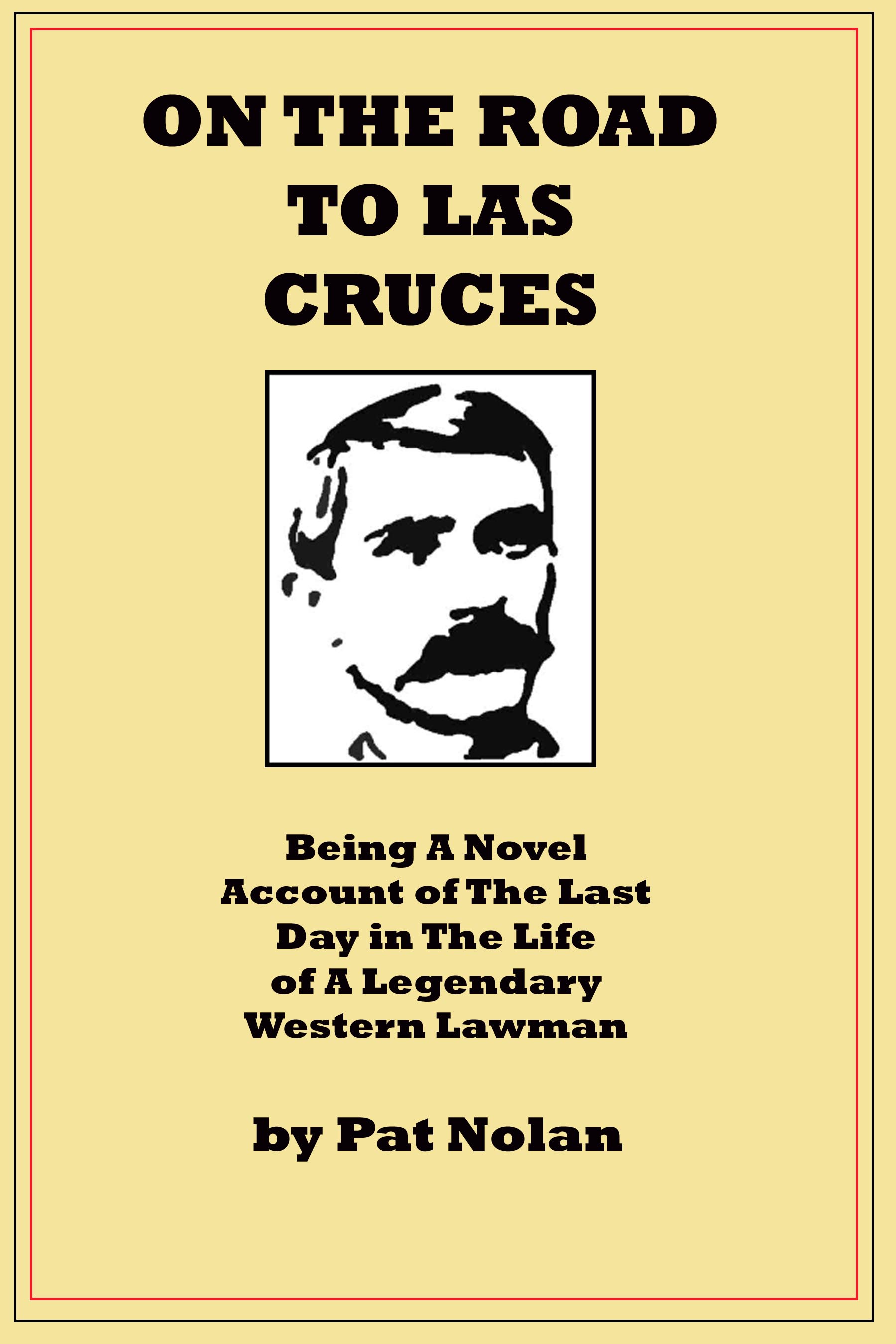
Q: One of your recently published novels, On The Road To Las Cruces, is a western. Is this the same novel?
A: It’s the same subject, but the narrative has changed considerably. Even though I had put it aside, the story and the need to tell it stayed with me, and I would go back and rewrite parts or scribble in the margins my additions or redirections. That went on for several years and finally computers caught up with me and I spent many hours transcribing my typewritten poetry manuscripts as computer documents. I also transcribed my western which allowed me to incorporate some of the revisions I had arrived at. And in the process of transcribing, I also rewrote.
Q: Technology benefitted your processes, in other words.
A: Technology always changes the way you do business. Writing a novel is no different. And as an added advantage, word processors allow, among other things, cut and paste techniques at one time available only to film editors.
Q: Are you utilizing those tools the way they are in the cinema?
A: In a way, yes, because cinema is a popular story telling art that uses narrative in interesting, innovative ways. In doing so, certain idioms are coined, clichés generated. Telling the story on the page can utilize these idioms, techniques, in similar ways since the reading audience and movie goers overlap and recognize the tropes. I was particularly conscious of using cinematic techniques in the western, mainly because of the complexity of trying to tell the story on three different levels. There’s the narrative that takes place in real time, the one that takes place in the recent past, and the narrative that’s as a result of introspection and dialogue with a ghost.
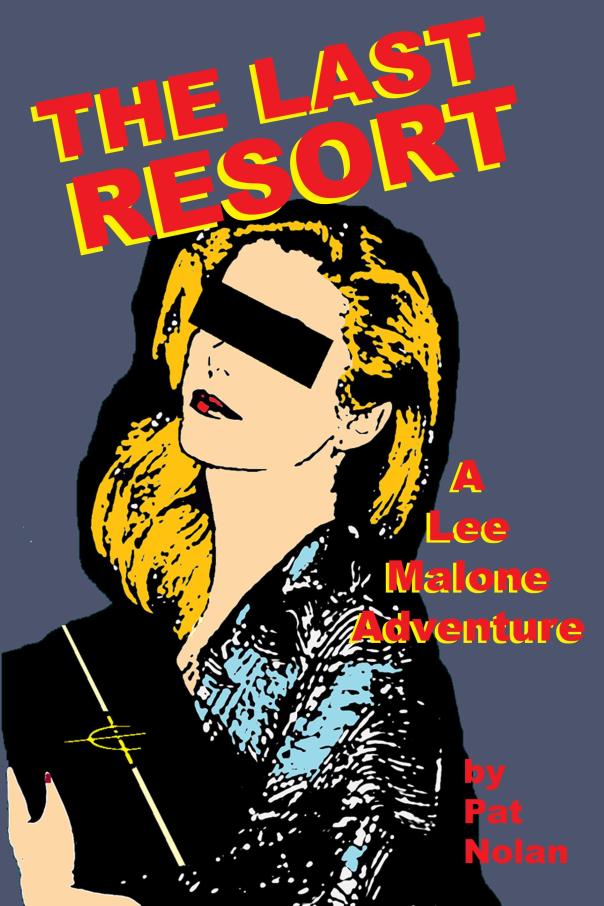
Q: Did you also use cinematic techniques in the novel you published last year, The Last Resort?
A: The narrative in The Last Resort has a fairly straight forward first person camera eye chronology with an extended back story flash back that serves as the booster rocket into the wrap up. There’s also the cinematic technique of the cliffhanger, the Saturday matinee movie serial. The chapters, which for the most part are all roughly the same length, end abruptly or as jump cuts.
Q: You’ve subtitled the novel A Lee Malone Adventure.
A: Lee Malone is based on a character I created for a serial I wrote for a local weekly newspaper years ago about a supermodel sleuth. I had started some preliminary chapters for another serial when the editorship changed hands and the newspaper was no longer interested in the material. These odds and ends of fiction were among the last to be transcribed as computer documents, and I didn’t pay that much attention to them until some years after that when I read a couple chapters to a few writers I know. Their reaction told me that I might be on to something. So I pursued it.
Q: Your first person narrator is a woman. Why a woman, and who is she?
A: Lee Malone is a stereotypical beautiful woman, former international model circa 1985. What makes her interesting is how she tries to circumvent that cliché and become an authentic person . In the very limited realm of a not overly realistic genre storyline, of course. The protagonist for these kinds of escapades is usually a tough guy with a broken nose, a five o’clock shadow, and breath that can pickle squid. I was after something different.
Q: The Last Resort was published in 2012. Why is the setting in 1985? Why not a more contemporaneous time?
A: I had started the early chapters in 1985. And rather than go back and retool the time frame to something more current, I decided to stick with it and avoid as many anachronisms as possible. No cell phones or internet back then so that allowed a slower unfolding of the plot and a more leisurely development of the back story on Lee Malone.
Q: You portray Lee Malone as rather willful.
A: She has a cocksureness instilled by her life of privilege as a beauty. And she knows how to use her looks to get what she wants. But there’s a down side, and that is that all men lust after her and most women hate her. Her aloofness is also a tragic flaw. Men are cowed by her imperiousness and women suspect her of treachery. Consequently she is alone.
Q: You’ve published two genre novels, one a western and the other a pot boiler. Are you seeking a conventional audience as opposed to one that was primarily interested in your poetry?
A: The interest in my poetry in a very qualified sense has always been limited. I don’t expect that my novels will be read by many more people, conventional or otherwise. Given that the novels are written by a poet, conventionality was never a consideration. Other than to label them genre works. Also this imagined audience will undoubtedly encompass many who have read my poems. Anyway, the idea of an audience for my work is always problematic. I don’t think that my subject matter and how I approach it has universal appeal. What I write about and how I write might find more support among men than woman. The western is about gun violence, and the pot boiler, as you characterize it, is about titillation. These are two things that fascinate men, sex and death.
Q: Are there more macho centric gender specific novels in your future?
A: I’m currently working on two crime fiction novels and a series of short stories in the same genre. They’re detective stories, dick lit, if you will. Dick signifying slang for detective, of course, not the male sexual organ. One is titled simply, A Detective Story, and the other is in between titles right now.
Q: Why crime fiction, dick lit, rather than something more universal that appeals to everyone?
A: Crime fiction actually has a universal appeal, at least since Poe, who is said to have pioneered the detective story. It is essentially comedy, sometimes quite dark, and situational, often improbable. I feel comfortable with the conventions of genre fiction. One novel, a period piece set in the 40’s before the war, is an attempt to represent the kind of writing that was being published in the pulp magazines with a little twist of French surrealism. The other might be characterized, in an 8 second Mamet pitch, as young Philip Marlowe in the 21st century.
Q: Let me see if I have that right, you’re writing genre novels in order to write about genre novels. Would you call that meta-fiction?
A: I might, but I don’t exactly know what that is. My characters are fictional, there’s no pretense that they are anyone beyond the page, even if they represent figures in regional history or in the history of fiction. Every time I sit down to write a poem I am writing the history of poetry. Not in any grand ultimate critique, but in the relationship between myself and poetry. In the same way, when I sit down to write a novel I am writing the history of fiction. I have a hyper awareness of what has been written and I naturally factor that into the process
Q: You’re mimicking a style appropriate to the story you’re telling. Is that how you approach writing all your novels?
A: I don’t know. I’ve only written two so far. But yes, there is an awareness of the genre that determines how, stylistically, it is written. Writing novel scale fiction requires a degree of engineering, of being more than just a voice but a writer director producer set designer camera lights action. I assume that anytime a story is told some kind of mimicry is going on.
Q: For example.
A: Um, for example, ok. Well, after the first version of my western was rejected, I was still enjoying my readings in the history of the old Southwest. This is a subject that had also fascinated me as a young reader. The more I read, the more of a historical sense I got of the people, the actors upon whom western legends are based. I read authors from that period, Owen Wister for instance, author of The Virginian, contemporary accounts by Charlie Siringo, and modern regional authors like J. Frank Dobie to get a sense of how the stories of that time were told. In rewriting the western, I had those voices to accompany me in the telling of my story. Or stories, as there are four stories, told by different storytellers or story telling devices. What I was after was an underlying tone, a lingering in the language from that time. In doing so, I didn’t write a conventional western. It is more matter of fact, laconic, about a subject that has been mined repeatedly. I gave it a different spin.
Q: You refer to your reading quite a bit. How much of a role does reading play in your writing?
A: Reading is the other side of the coin. I spend as much time reading as I do writing, maybe more. I don’t read much fiction though. I read primarily to satisfy my curiosity about particular subjects. Neuroscience or cosmology, the micro and the macro of it all. Sociology, anthropology, history. These are areas of scholarship that continue to interest me. To speculate on any of these subjects is what engages the imagination for me. Coming at it from another way, writing genre novels is a reaching back to the reading that I enjoyed so much when I was younger and inspired me to think I could be a writer, a time of innocence that existed before I stepped into the world of serious literature.
Q: Now that you are heavily committed to novel pursuits, have you put aside writing poetry for the time being? Or for good?
A: Yes, for the good of poetry, I should actually stop, but no, that obsession continues unabated. And it’s not like I put on a different hat when I sit down to do one or the other. To paraphrase Philip Whalen, it is something I do all day, every day. I give the novels the same attention and concentration I give to my poetry. And the fact that I am primarily a poet simply means that I bring a peculiar sense of language to the table. These novels might easily be considered very long prose poems, poems on an epic scale.
Based on an interview conducted by Suzanne Lang for A Novel Idea aired on KRCB FM (Rohnert Park, CA) February 13th, 2013; edited, condensed, with material added for continuity and coherence.